

TL;DR:
- Automation and AI are transforming workforce management by increasing efficiency and reducing errors.
- Mobile-first tools enhance engagement and accuracy for frontline workers through real-time updates and GPS verification.
- Centralized platforms streamline HR processes, reduce costs, and improve compliance across multiple locations.
Workforce management in 2026 is not a slow-moving discipline anymore. HR managers across retail, hospitality, healthcare, and manufacturing are being asked to make faster, smarter decisions about scheduling, retention, and technology adoption, often with fewer resources and tighter margins. The six trends covered here are not abstract predictions. They are reshaping daily operations right now, and the organizations that align their strategies with even two or three of them are already pulling ahead. Understanding which trends deserve your attention and investment could be the most important strategic decision you make this year.
Table of Contents
- Automation and AI: Redefining workforce efficiency
- Mobile-first management: Empowering a flexible workforce
- Data-driven decision making and predictive analytics
- Employee experience and well-being at the core
- Integrated platforms and centralized management
- Why following every trend may backfire: A pragmatic approach
- Transform your workforce strategy with Zeppri
- Frequently asked questions
Key Takeaways
| Point | Details |
|---|---|
| Automation adoption | AI and automation are driving major efficiency gains in workforce management. |
| Mobile-first tools | Mobile apps are now essential for real-time workforce coordination, especially in shift-based sectors. |
| Data-driven insights | Predictive analytics empower HR to plan proactively and reduce turnover. |
| Employee well-being | Prioritizing staff well-being leads to higher retention and productivity. |
| Centralized platforms | Unified management systems streamline HR operations and decision making. |
Automation and AI: Redefining workforce efficiency
With the challenge of adapting to fast-evolving strategies in mind, the first major trend is the integration of automation and AI throughout workforce management. Automation and AI adoption is increasing productivity across key industries, and HR is no longer an exception.
What does this look like in practice? Consider how scheduling used to work: managers manually juggled availability, skill sets, and compliance rules. AI-powered engines now handle that in seconds. Automation in time tracking eliminates manual entry errors and gives payroll teams clean, audit-ready data every single week.
Key benefits AI brings to workforce management today:
- Reduced scheduling errors through intelligent conflict detection
- Optimized shift assignments based on historical productivity data
- Predictive turnover alerts so retention efforts can start early
- AI chatbots handling routine employee queries around leave balances and shift swaps
The less obvious benefit is how much time managers reclaim. When routine tasks are automated, HR leaders can focus on strategy instead of firefighting.
"AI doesn't replace HR judgment. It eliminates the noise so that judgment can be applied where it matters most."
That said, ROI is not automatic. Implementation challenges are real: data quality issues, resistance from long-tenured staff, and integration with legacy payroll systems can all slow progress. Using centralized schedule management as a foundation before layering AI on top reduces those friction points considerably.
Pro Tip: Start a pilot project in a single department before rolling out AI tools org-wide. Measure accuracy, time savings, and adoption rates for 60 days before scaling.
Mobile-first management: Empowering a flexible workforce
While automation helps at the macro level, mobile-first tools drive change directly in employees' hands. Mobile apps are rapidly changing workforce management in high-turnover sectors like hospitality and retail, and the shift is accelerating.

Frontline workers rarely sit at desks. They clock in from a warehouse floor, a hotel lobby, or a patient care unit. Expecting them to interact with HR systems through a desktop portal is a disconnect that costs engagement and accuracy. Mobile-first platforms close that gap.
Core features driving adoption:
- Real-time shift swaps with manager approval built in
- Instant push notifications for schedule changes and urgent updates
- Mobile clock-in and clock-out with GPS verification for field workers
- Self-service leave requests that reduce back-and-forth emails
Knowing which essential mobile app features your workforce actually needs, versus which ones add complexity, is crucial before selecting a platform. Not every team needs every feature on day one.
The mobile clock-in advantages go beyond convenience. Geofencing ensures employees are physically on-site before clocking in, which directly reduces time theft and buddy punching, two persistent problems in shift-based industries.
Challenges worth planning for include device management policies, data security on personal phones, and the reality that some employees are less tech-savvy than others.
Pro Tip: Before launch, run a short training session and designate a few tech-comfortable employees as peer support leads. Adoption rates climb significantly when help comes from a coworker rather than IT.
Data-driven decision making and predictive analytics
With mobile solutions boosting engagement, leveraging data further empowers HR leaders for proactive planning. Real-time dashboards are replacing gut-feel decisions, and predictive modeling is helping organizations get ahead of labor problems before they become crises.
Predictive analytics enables better talent allocation and anticipates labor spikes, which is especially valuable for industries with seasonal demand cycles. Think of a retail chain preparing for a holiday surge or a healthcare network managing flu season staffing.
Key workforce metrics HR leaders are now tracking in real time:
- Turnover rate by department and shift
- Overtime hours as a percentage of total labor cost
- Productivity per shift, tracked against historical benchmarks
- Retention risk scores generated from engagement and attendance patterns
Here is a quick look at how analytics maturity levels affect decision quality:
| Analytics level | Focus | Example action |
|---|---|---|
| Descriptive | What happened | Review last month's overtime report |
| Diagnostic | Why it happened | Identify high-overtime departments |
| Predictive | What will happen | Flag teams at risk of burnout next quarter |
| Prescriptive | What to do | Recommend targeted upskilling or cross-training |
Organizations that move beyond descriptive reporting into predictive and prescriptive models see faster, better workforce decisions. Knowing your efficient shift scheduling data is clean and consistent is a prerequisite for this kind of analysis.
Employee experience and well-being at the core
While data directs high-level strategy, employee experience is the on-the-ground reality shaping outcomes. Organizations that treat well-being as a checkbox are losing talent to those that treat it as a competitive advantage.
Focusing on well-being and engagement improves retention rates, and in frontline sectors like hospitality and healthcare, even a small retention improvement has an outsized financial impact due to replacement costs.
Practical well-being measures gaining traction in 2026:
- Flexible scheduling that gives employees input into their own shifts
- Wellness programs integrated into the employee app or platform
- Anonymous feedback channels that surface problems before they become attrition
- Mental health days treated with the same legitimacy as sick leave
Healthcare organizations in particular are seeing fast results from flexible shift structures. Nurse burnout has been a documented crisis, and organizations giving staff more schedule control report measurable improvements in both satisfaction and retention.
"Prioritizing well-being isn't just nice to have. It's now essential for retention in any industry where talent has real options."
Using a solid time tracking guide helps HR teams monitor overtime patterns that often signal burnout before an employee actually resigns. Data and empathy, used together, create the most effective retention strategy.
The well-being in workforce strategies approach works best when it is tied to real scheduling flexibility rather than just wellness perks. Perks without schedule control ring hollow to frontline workers.
Integrated platforms and centralized management
Pulling these trends together, many organizations are investing in unified platforms for end-to-end workforce management. The era of running separate tools for scheduling, time tracking, payroll, and communications is ending fast.
Centralized platforms are streamlining HR administration and reducing redundant workflows, which matters enormously for multisite employers in manufacturing and retail who are managing dozens of locations from one admin team.
Single platform vs. multiple tools: A quick comparison
| Factor | Single integrated platform | Multiple separate tools |
|---|---|---|
| Efficiency | High, data flows automatically | Low, manual syncing required |
| Cost | Lower total cost of ownership | Higher, multiple licenses and integrations |
| Compliance | Centralized audit trail | Fragmented, higher risk |
| Ease of use | One login, unified experience | Multiple logins, training overhead |
For organizations thinking about making the move to centralized workforce management, here are three practical steps to get started:
- Audit your current tools. Map every system your HR team touches daily and identify duplication.
- Define your must-have features. Prioritize scheduling, time tracking, and compliance reporting as the core.
- Run a parallel pilot. Operate your new platform alongside existing tools for 30 days before cutting over.
Manufacturing environments deserve special attention here. Multiple shifts, complex compliance requirements, and large workforces make a single source of truth not just convenient but operationally critical.
Why following every trend may backfire: A pragmatic approach
After reviewing these six trends, the instinct might be to start implementing all of them immediately. Resist that instinct. In our experience working with HR teams across industries, the organizations that struggle most are not the ones who do too little. They are the ones who do too much, too fast.
There is a real cost to trend fatigue. When employees see a new platform, policy, or process every few months, trust in leadership erodes. Adoption drops. Change management becomes reactive instead of intentional.
The most effective HR leaders we see treat technology adoption like a clinical trial. They pick one high-impact area based on their biggest pain point, whether that is turnover, compliance errors, or scheduling inefficiency, and they pilot it with a defined team. They measure outcomes. They gather mobile workforce management insights from the people using the tools, not just the managers watching dashboards. Then they decide whether to scale.
Align adoption with your culture and your business reality. A 500-person manufacturing operation has very different needs than a 40-person restaurant group. One framework does not fit all.
Pro Tip: Score each trend against two questions: Does it solve a problem we already feel? Are we ready to support adoption right now? If the answer to either is no, it stays on the watch list, not the implementation roadmap.
Transform your workforce strategy with Zeppri
If these trends feel overwhelming to tackle alone, that's exactly the problem a purpose-built platform solves. Zeppri brings scheduling, time tracking, attendance management, and real-time analytics into one unified workspace, so HR managers in retail, hospitality, healthcare, and manufacturing can act on these trends without juggling five different tools.
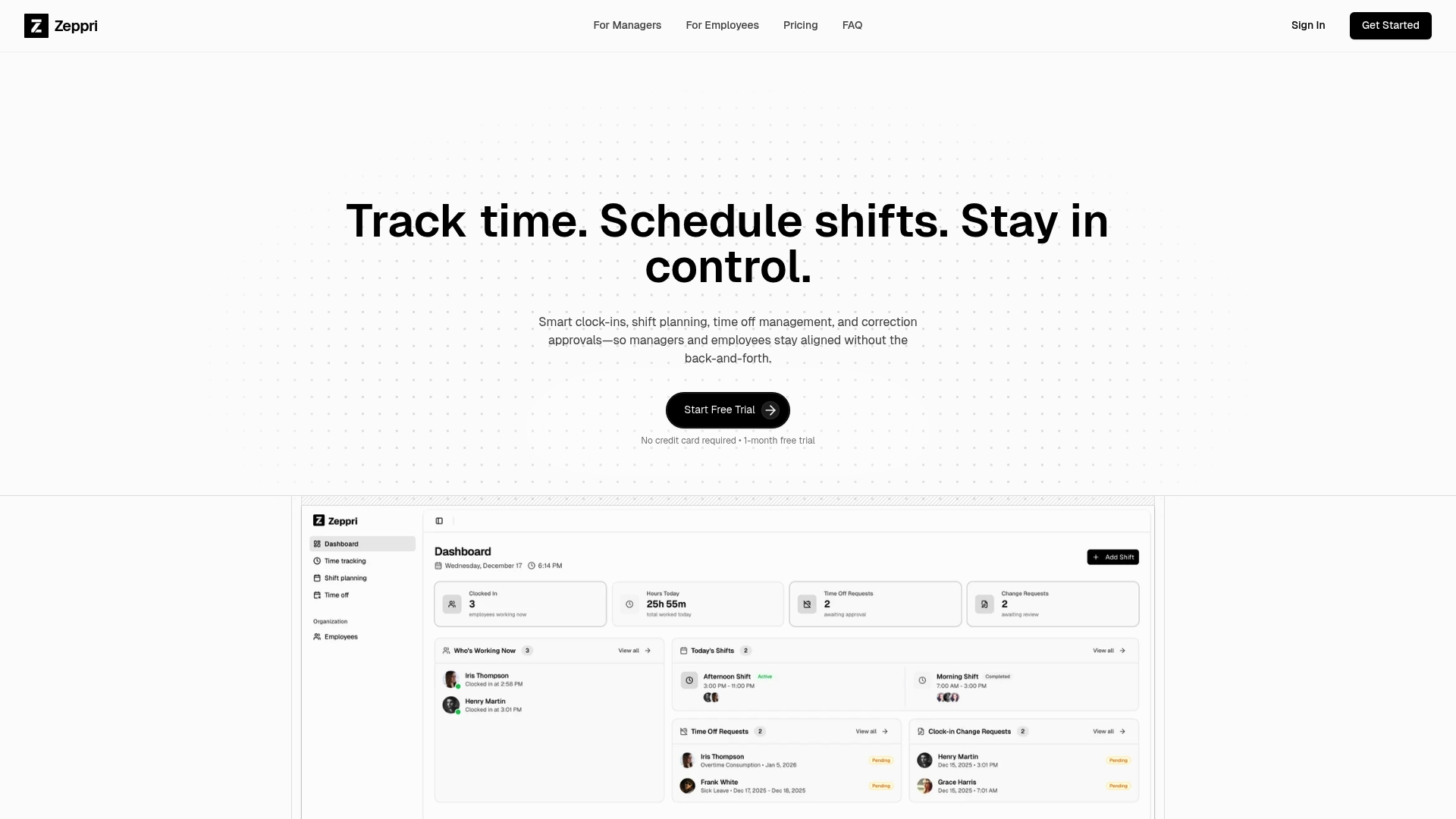
From digital transformation insights to daily operational workflows, Zeppri is built to scale with your organization's needs. Whether you're managing 20 employees or 2,000, the Zeppri platform gives you the visibility and control to turn 2026's biggest workforce trends into real competitive advantages. Book a demo today and see how quickly your team can get up and running.
Frequently asked questions
What are the biggest challenges to adopting AI in workforce management?
Common challenges include resistance to change from existing staff, difficulty integrating AI tools with legacy payroll and HR systems, and ensuring data privacy and transparency throughout implementation. Starting with a defined pilot reduces all three risks.
Why are mobile apps essential for shift-based industries in 2026?
Mobile apps enable real-time scheduling, time tracking, and communication, improving flexibility and reducing absenteeism. This is especially critical in retail, hospitality, and healthcare where frontline workers need instant access to shift information.
How do predictive analytics benefit HR managers?
Predictive analytics help anticipate turnover and optimize staffing levels before problems surface, enabling targeted development programs and smarter resource allocation across departments.
What's the ROI of integrated workforce management platforms?
Centralized platforms reduce administrative time and errors by eliminating redundant data entry, streamlining communications, and creating a single audit trail that supports both compliance and operational efficiency.