

TL;DR:
- Effective mobile workforce management apps should prioritize features like clock-in, geofencing, real-time scheduling, and reporting.
- Adoption depends on clear management buy-in, user-friendly design, and gradual feature implementation.
- Choosing the right app involves assessing team needs, pain points, budget, and trial feedback to ensure seamless integration and security.
Managing a team across multiple locations, shifts, and time zones is genuinely hard. You're making real-time decisions while fielding messages, reviewing schedules, and chasing down attendance records, often from your phone. The mobile app market promises to fix all of this, but the sheer number of options creates its own problem: how do you know which features actually move the needle? Picking the wrong tool wastes time, frustrates staff, and leaves critical gaps in your operations. This article cuts through the noise and identifies the features that matter most for managers who need results, not just a longer feature list.
Table of Contents
- How to evaluate mobile app features as a manager
- Must-have features for mobile workforce management apps
- Comparing leading apps: feature breakdown
- How to choose the right app for your team's needs
- Our take: Why app adoption succeeds or fails for managers
- Unlock better management with the right app features
- Frequently asked questions
Key Takeaways
| Point | Details |
|---|---|
| Focus on core needs | Start by identifying your team's specific pain points before evaluating apps. |
| Prioritize usability | Choose intuitive, user-friendly features to speed up adoption and maximize value. |
| Compare features objectively | Use side-by-side comparisons to ensure all essential app features are covered. |
| Review security and integration | Always check for data security and compatibility with existing systems. |
How to evaluate mobile app features as a manager
Before you download a single app or sit through a demo, you need to get clear on what your team actually struggles with. Are you losing hours to manual timesheet corrections? Do shift changes create chaos because there's no central communication channel? Knowing your specific pain points shapes every evaluation decision you make from here.
Once you've named your problems, run every candidate app through these core criteria:
- Scalability: Can the app handle 10 employees today and 200 next year without a full platform switch?
- Integration: Will it connect to your existing payroll, HR, or project management tools without custom development?
- Ease of use: If your staff finds the interface confusing, adoption will stall regardless of how powerful the feature set is.
- Security and compliance: Workforce data includes sensitive personal and financial information. The app must offer encrypted storage and role-based access controls.
- Reporting depth: Surface-level dashboards aren't enough. You need exportable, filterable data that supports payroll runs and compliance audits.
Adoption is the silent killer of good software investments. An app that your team refuses to use is worse than no app at all, because it creates a false sense of having solved the problem. Mobile apps streamline efficiency and accountability when the right features are matched to real workflows.
Pro Tip: Before committing to any app, run a two-week pilot with a small cross-section of your team. Include both tech-savvy staff and those who are less comfortable with new tools. Their combined feedback will reveal friction points that a demo never will.
Finally, think about onboarding time. A powerful app that takes three months to implement fully is a liability for fast-moving teams. Prioritize platforms that offer quick setup, clear documentation, and responsive support.
Must-have features for mobile workforce management apps
With a solid evaluation framework in place, let's talk about the specific features that belong on every manager's non-negotiable list.
Mobile clock-in and geofencing sit at the top. Geofencing uses GPS boundaries to verify that employees are physically at the correct location when they clock in. This eliminates buddy punching (when one employee clocks in for another) and gives you location-verified attendance records without any manual oversight.

Real-time shift scheduling is equally critical. Shift changes happen fast, and a static spreadsheet can't keep up. Look for apps that let you drag and drop shifts, send instant notifications to affected staff, and flag scheduling conflicts automatically. Solid time tracking features and scheduling tools together form the operational backbone of any workforce app.
Task assignment and progress tracking bring project visibility into the same platform. Instead of switching between a scheduling app and a task manager, you can assign work, set deadlines, and monitor completion from one screen.
In-app communication reduces the noise from personal messaging apps. Alerts, shift confirmations, and feedback loops all stay inside the platform, creating a documented record of team interactions.
Instant reporting closes the loop. According to accurate scheduling research, accurate time tracking and scheduling are crucial for professional services, and real-time reports let you act on that data before small issues become expensive problems.
For field-based teams, tools like JobClock time tracking demonstrate how location-aware time tracking can transform accountability for workers who are rarely at a fixed desk.
Pro Tip: Prioritize apps that push alerts to managers when an employee misses a clock-in. Passive monitoring requires you to look for problems. Active alerts bring problems to you.
Stat to know: Teams using automated scheduling and mobile clock-in report significant reductions in payroll errors and time spent on manual corrections, freeing managers for higher-value work.
Comparing leading apps: feature breakdown
Seeing a feature list is one thing. Seeing how apps actually compare across those features is where decisions get easier. Mobile task and project management tools are built specifically for managers in professional services, but not all of them cover every base.
Here's a practical comparison across six key feature categories:
| Feature | Zeppri | App B | App C |
|---|---|---|---|
| Mobile clock-in and geofencing | Yes | Yes | No |
| Real-time shift scheduling | Yes | Partial | Yes |
| Task assignment and tracking | Yes | No | Yes |
| In-app communication | Yes | Yes | Partial |
| Automated reporting and export | Yes | Partial | No |
| HR and payroll integration | Yes | Yes | No |
A few patterns stand out immediately. Reporting and integration are the features most commonly cut from lighter apps. This matters because those are exactly the features that save managers the most time on administrative work.
When evaluating efficient scheduling methods and compliance requirements, organizations operating across multiple jurisdictions also need to consider workforce mobility compliance, which adds another layer of complexity to the feature evaluation.
"The features that get skipped in demos are usually the ones that matter most at month-end. Reporting and integration are invisible until you desperately need them."
Here's what to watch for when reviewing any comparison:
- Partial support often means the feature exists but requires manual workarounds or premium add-ons.
- Integration depth varies widely. Ask specifically whether the connection is native or relies on a third-party connector.
- Security certifications should be listed clearly in the vendor's documentation, not buried in fine print.
Take the comparison table as a starting point, not a final verdict. Always verify current feature availability directly with each vendor before making a decision.
How to choose the right app for your team's needs
The comparison gives you a map. Now you need to navigate it based on your specific terrain. Here's a practical four-step process:
- Define your team profile. Note team size, roles (field workers vs. office staff), shift patterns, and geographic spread. A retail team with 40 part-time staff has very different needs than a 12-person healthcare unit.
- Map pain points to features. Use the table below to connect your biggest operational headaches to the features that address them directly.
- Set a realistic budget. Per-user pricing models can scale quickly. Calculate the total cost at your current team size and at projected growth over 12 months.
- Run a trial and collect feedback. Accuracy with mobile clock-in only improves if staff actually use the tool consistently. Gather structured feedback after two weeks and adjust before committing to an annual contract.
For teams where workers are frequently off-site, JobClock for accuracy highlights how accurate mobile time tracking supports better operations and billing, particularly in field service and construction environments.
| Pain point | Feature to prioritize |
|---|---|
| Buddy punching and attendance fraud | Geofencing and mobile clock-in |
| Payroll errors from manual timesheets | Automated time tracking and export |
| Last-minute shift chaos | Real-time scheduling with notifications |
| Poor team communication | In-app messaging and alerts |
| Compliance and audit readiness | Detailed reporting and data retention |
| High admin workload | HR and payroll integrations |
One often-overlooked factor is onboarding speed. A tool that requires a two-day training session will face resistance. Look for platforms with intuitive interfaces that staff can navigate confidently within a single shift.
Our take: Why app adoption succeeds or fails for managers
Here's something most vendor comparisons won't tell you: the feature list is almost never the reason an app fails. Adoption fails because managers underestimate the human side of the rollout.
When a manager treats a new app as an IT project rather than a team change, resistance builds fast. Staff see it as surveillance, not support. The framing matters enormously. Present the tool as something that makes their work easier, not something that watches them.
Manager buy-in is the single strongest predictor of whether a team actually uses a new platform. If you're skeptical of the tool yourself, your team will feel it. Use the app visibly. Reference data from it in team meetings. Show that it informs real decisions.
Counter-intuitively, more features can hurt adoption. An app with 20 capabilities that nobody uses creates cognitive overload. Start with three core features, get your team comfortable, then expand. Platforms like the Zeppri workforce app are built with this in mind, offering scalable feature access that grows with your team's comfort level.
Finally, treat adoption as an ongoing process. Review usage data monthly. Ask which features staff actually use and which ones they avoid. Iterate. The teams that get the most from workforce apps are the ones that treat the tool as a living system, not a one-time purchase.
Unlock better management with the right app features
You've just worked through the criteria, the must-have features, the comparison, and the selection process. The next step is finding a platform that checks all those boxes without requiring a six-month implementation.
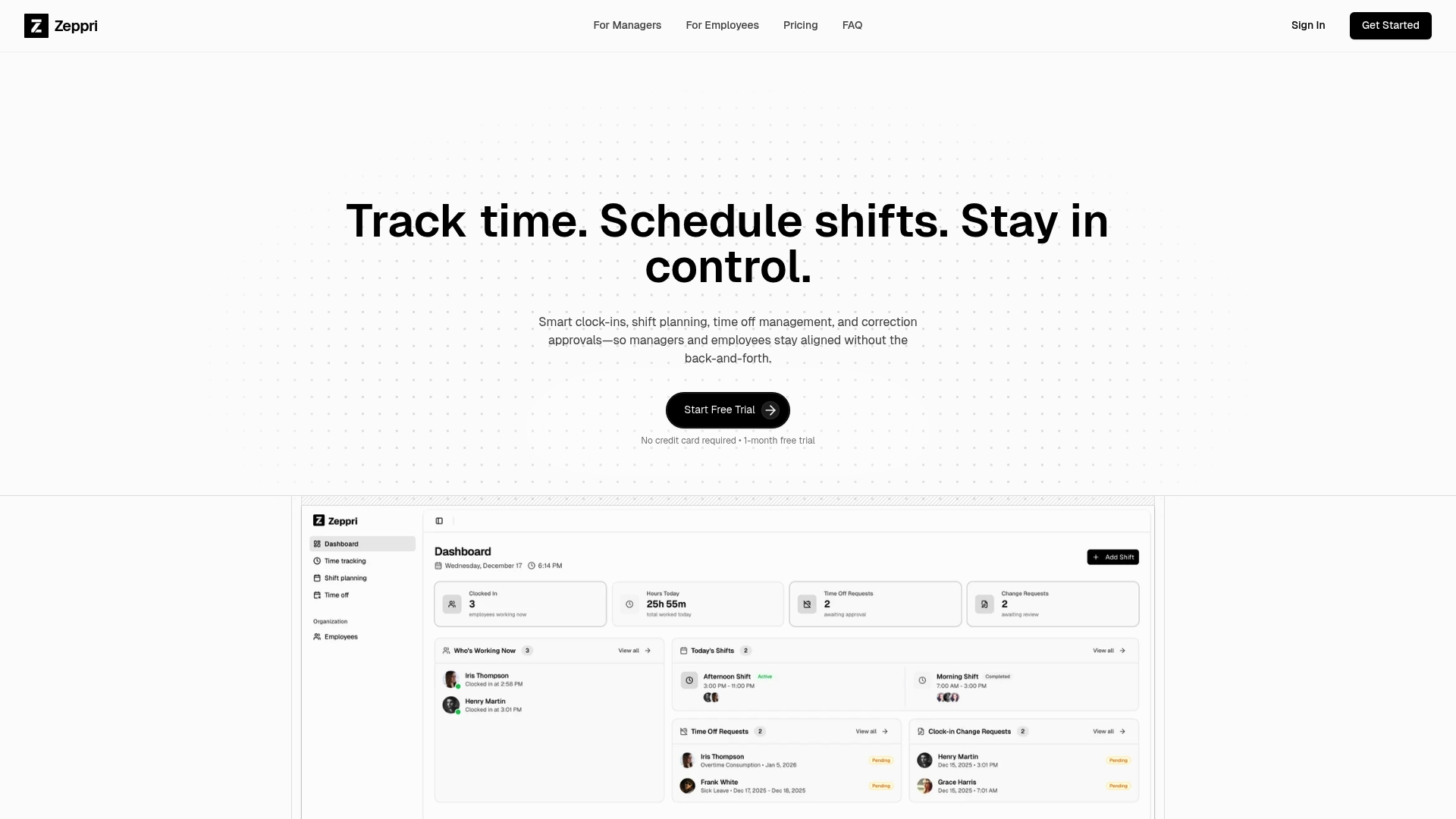
Zeppri brings together mobile clock-in, geofencing, real-time scheduling, in-app communication, and automated reporting in one platform built for managers who need results fast. Whether you're running a retail floor, a healthcare unit, or a distributed field team, the Zeppri workforce app is designed to reduce admin work, improve accuracy, and give you the visibility you need to lead confidently. Explore the full feature set and see how Zeppri fits your team's specific needs.
Frequently asked questions
What is the most important mobile app feature for managers?
Accurate time tracking is widely recognized as one of the most fundamental features for effective team management. Mobile apps with robust time tracking improve operations and reduce payroll errors for managers across industries.
How do mobile apps improve workforce accountability?
Mobile apps provide real-time tracking and instant visibility of team member actions, increasing transparency across the board. Mobile clock-in boosts accuracy and accountability by creating verified, timestamped attendance records that managers can review at any time.
Can mobile workforce apps integrate with existing HR systems?
Many top workforce apps offer native integrations with HR and payroll systems to ensure seamless data flow without manual re-entry. Mobile workforce apps can connect with other business platforms to centralize your operational data.
How do I ensure data security when using mobile management apps?
Choose apps that offer encrypted data storage, role-based access controls, and clear compliance documentation. Security and compliance are key considerations when evaluating any workforce management app for sensitive employee data.