

TL;DR:
- Centralized scheduling offers consistency, real-time visibility, and better labor cost control.
- Transitioning improves operational efficiency but requires phased rollout and staff engagement.
- Most organizations underestimate hidden costs of decentralization, like shadow admin work and missed insights.
Most operations managers assume that letting each location or department handle its own scheduling creates flexibility. In practice, it often creates the opposite. Fragmented scheduling generates duplicate work, inconsistent coverage, and labor cost overruns that rarely surface until payroll is already processed. For small to medium-sized organizations managing multiple teams or sites, the hidden costs of decentralized scheduling accumulate fast. This guide breaks down the real differences between centralized and decentralized approaches, makes the case for why centralization wins for most SMBs, and gives you a practical path to making the switch without disrupting your operations.
Table of Contents
- Understanding decentralized versus centralized schedule management
- The key benefits of centralized schedule management for SMBs
- Addressing challenges and overcoming transition hurdles
- Real-world results: How centralization transforms workforce management
- Why most operations managers underestimate the real costs of decentralization
- Move toward smarter, centralized scheduling with modern tools
- Frequently asked questions
Key Takeaways
| Point | Details |
|---|---|
| Centralization reduces errors | Managing schedules centrally cuts inconsistencies and costly mistakes. |
| Boosts operational visibility | A centralized system lets managers see labor needs and coverage in real time. |
| Streamlines compliance | Centralized scheduling simplifies meeting labor law requirements as you grow. |
| Smoother scaling | It’s easier to expand operations with a single, integrated scheduling platform. |
Understanding decentralized versus centralized schedule management
Decentralized schedule management means each department, location, or team lead builds and manages their own schedules independently. A retail chain where each store manager creates weekly rosters in a separate spreadsheet is a classic example. Centralized schedule management, by contrast, means all scheduling flows through a single system or team, giving one unified view of workforce allocation across the entire organization.
The distinction sounds simple, but the operational implications are significant. When scheduling is fragmented, you end up with inconsistent shift rules, varying overtime thresholds, and no easy way to move staff between locations when coverage gaps appear. As your organization grows, those inconsistencies compound. What worked for two locations becomes unmanageable at five.
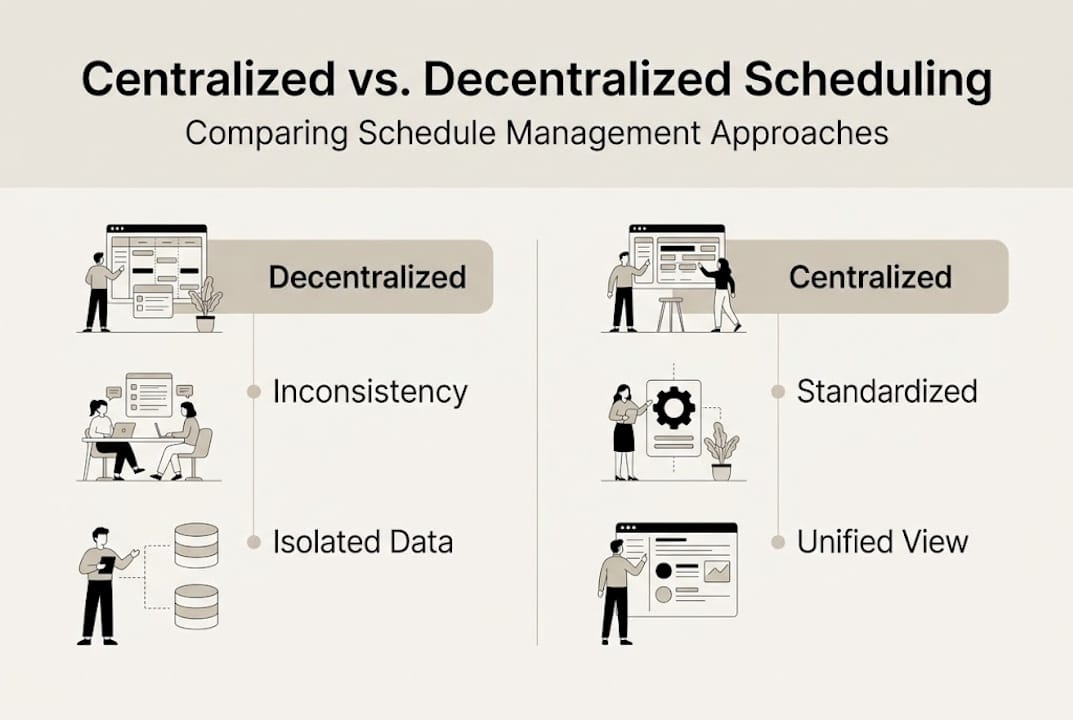
Here is a direct comparison of how the two approaches differ across key operational dimensions:
| Factor | Decentralized | Centralized |
|---|---|---|
| Consistency | Varies by location | Standardized across all sites |
| Visibility | Limited to local view | Real-time, organization-wide |
| Labor cost control | Difficult to track | Easier to monitor and optimize |
| Compliance | Inconsistent application | Uniform rule enforcement |
| Scalability | Breaks down as you grow | Scales with the organization |
Decentralized systems do offer one genuine advantage: local managers can respond quickly to immediate needs without waiting for approval. But that speed comes at a price. As centralized vs. decentralized analysis shows, decentralized scheduling leads to inconsistencies, redundancies, and higher costs, while centralized approaches excel in standardization for multi-location SMBs.
The core issues with decentralization tend to surface in these ways:
- Duplicate admin work: Multiple managers re-creating the same scheduling logic independently.
- Coverage blind spots: No one sees the full picture, so gaps go unnoticed until it is too late.
- Inconsistent employee experience: Staff at different locations operate under different rules, causing friction and confusion.
- Compliance risk: Labor law requirements get applied unevenly when there is no central oversight.
For a deeper look at building efficient shift structures from the ground up, the efficient shift scheduling guide walks through practical frameworks you can apply immediately.
The key benefits of centralized schedule management for SMBs
With the core differences clear, let's focus on the specific advantages a centralized approach offers SMB operations managers. These are not theoretical gains. They show up in your daily workflow, your payroll accuracy, and your ability to scale without adding headcount.
Here are the five benefits that matter most:
- Reduced scheduling inconsistencies: One system, one set of rules. Every location follows the same shift structure, overtime policy, and coverage standard.
- Real-time visibility: You see who is working, where, and when across every team or site, without chasing down individual managers for updates.
- Labor cost control: Centralized data makes it easy to spot overtime trends, underutilized staff, and scheduling inefficiencies before they hit your budget.
- Labor law compliance: Consistent rule enforcement means you apply break requirements, maximum hours, and rest period rules uniformly, reducing your legal exposure.
- Easier scaling: Adding a new location or team does not require building a new scheduling process from scratch. You replicate what already works.
Technology is the enabler that makes all of this possible at scale. Centralized scheduling excels in SMB and multi-location standardization precisely because modern platforms can handle the complexity that spreadsheets cannot. Features like mobile clock-in for accuracy give you verified, real-time attendance data feeding directly into your centralized view.

Pro Tip: When migrating to a centralized system, do not try to import all your existing scheduling data at once. Start with one location or team, validate the process, and then roll out to others. Rushing the migration often means carrying old errors into the new system.
The numbers back this up. Organizations that move to centralized workforce management consistently report fewer scheduling errors and lower administrative overhead. When your scheduling data lives in one place, you spend less time reconciling conflicting information and more time making decisions that actually improve operations.
Addressing challenges and overcoming transition hurdles
While centralizing schedules offers substantial benefits, transitions can be tricky. The most common obstacles are not technical. They are human.
Here is what you will typically encounter when shifting to centralized scheduling:
- Resistance from local managers: Supervisors who have controlled their own scheduling often see centralization as a loss of autonomy. Address this early by involving them in the design process.
- Training gaps: Staff and managers need time to learn a new system. Underestimating this slows adoption and creates frustration.
- Integration challenges: Your scheduling system needs to connect with payroll, HR records, and time tracking. Gaps here create manual workarounds that defeat the purpose.
- Process inconsistencies during transition: Running two systems in parallel, even briefly, introduces errors. Plan for a clean cutover with clear timelines.
"Adopting technology workflow solutions is not just about replacing a spreadsheet. It is about redesigning how decisions get made, who has visibility, and how accountability flows through the organization."
The most effective way to handle these hurdles is a phased rollout. Start with your most straightforward location or department. Use that first phase to identify gaps in your process, train your team on the new system, and build internal confidence before expanding. Adopting technology solutions plays a key role in successful centralization, but only when the rollout is structured thoughtfully.
For a practical framework on building centralized scheduling processes that stick, it helps to map your current workflow before you configure anything in the new system. Know where decisions currently get made and who needs to be involved in the new model.
Pro Tip: Assign a scheduling champion at each location during the transition. This person becomes the go-to resource for local questions and acts as your feedback channel for what is and is not working in the new system.
Staff engagement is not optional. When employees understand why the change is happening and see that the new system makes their own experience easier, such as cleaner shift notifications and simpler time-off requests, resistance drops significantly.
Real-world results: How centralization transforms workforce management
Theory is useful, but results matter most. Here is what centralization delivers in practice for SMBs that make the switch.
The table below shows typical outcomes organizations report after moving from decentralized to centralized scheduling:
| Outcome area | Before centralization | After centralization |
|---|---|---|
| Scheduling errors per month | 12 to 18 | 2 to 4 |
| Admin time on scheduling | 8 to 12 hours/week | 2 to 4 hours/week |
| Overtime cost overruns | Frequent, untracked | Visible and preventable |
| Coverage gaps | Discovered day-of | Flagged 48 to 72 hours ahead |
| Compliance incidents | Occasional | Near zero |
Consider a mid-sized hospitality company managing three locations with separate scheduling spreadsheets. Here is how their transition unfolded:
- Audit and map: They documented every scheduling rule, shift type, and approval workflow across all three sites. This revealed that each location was using different overtime thresholds and break rules.
- Pilot one location: They launched centralized scheduling at their smallest site first, using the new system for four weeks before touching the others. This surfaced three integration issues they fixed before the wider rollout.
- Full rollout with training: With lessons from the pilot applied, they rolled out to the remaining two locations over a single weekend. Staff training happened in advance, and a scheduling champion at each site handled day-one questions.
The result was a 60% reduction in scheduling admin time and a measurable drop in last-minute overtime. Centralization eliminates redundancies, boosts cost efficiency, and standardizes processes in ways that directly affect your bottom line.
For operations managers focused on accuracy, pairing centralized scheduling with accuracy and accountability tools like geofenced mobile clock-ins closes the loop between planned and actual hours worked.
The lesson here is straightforward. Centralization is not just an IT project. It is an operational upgrade that pays back in time, money, and visibility.
Why most operations managers underestimate the real costs of decentralization
These results are powerful, but there is an industry blind spot that deserves attention. Most operations managers only count the visible costs of scheduling problems: the overtime line on a payroll report, the unfilled shift that required a last-minute call. The real costs run deeper.
Decentralized scheduling creates shadow admin work. Managers spend hours reconciling conflicting schedules, chasing confirmations, and manually patching coverage gaps. None of that time appears on a scheduling report. It just disappears into the workweek.
There is also the missed upside. When you lack real-time visibility across your workforce, you cannot spot patterns. You cannot see that one location is consistently overstaffed on Tuesdays while another runs short. You cannot proactively redistribute labor before costs spike.
Standard advice on scheduling reform focuses on process improvements and better communication. That helps, but it does not address the structural problem. Decentralization makes data-driven oversight nearly impossible. Centralization does not just reduce errors. It changes what you are able to see and act on as a manager. That shift in capability is where the real operational return lives, and most organizations do not realize it until they have already made the switch.
Move toward smarter, centralized scheduling with modern tools
If the evidence in this article resonates, the next step is finding a platform built to make centralized scheduling practical rather than painful.
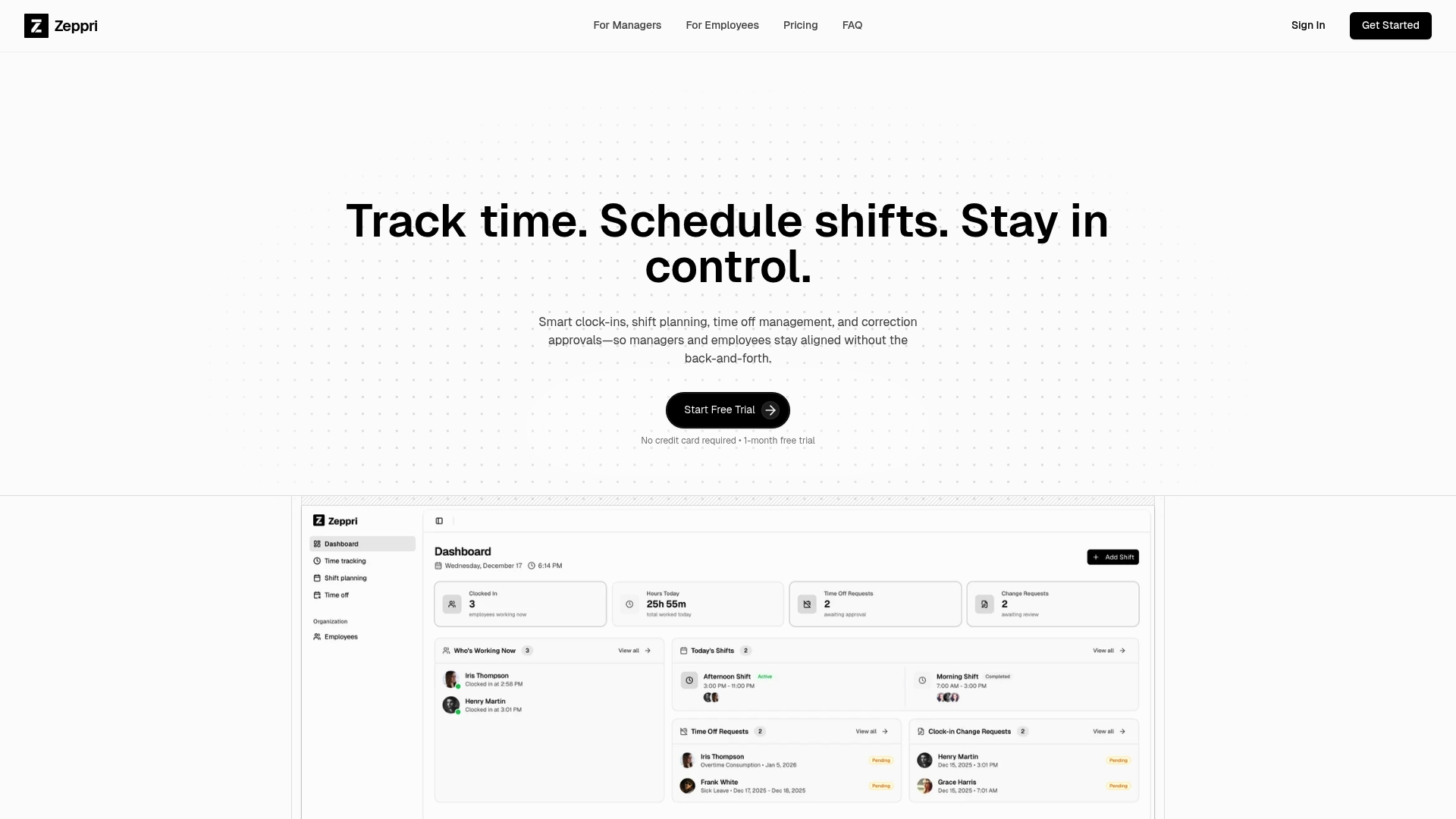
Zeppri centralized scheduling gives operations managers a single dashboard to plan shifts, track real-time attendance, manage time-off requests, and export clean data for payroll, all without the spreadsheet chaos. Geofencing, mobile clock-ins, and automated compliance rules are built in from day one. Whether you manage two locations or twenty, Zeppri scales with your operation and keeps your entire workforce visible from one place. Explore how Zeppri can replace the fragmented tools slowing your team down and give you the operational clarity you have been missing.
Frequently asked questions
What is centralized schedule management?
Centralized schedule management is a system where scheduling is controlled from one location or platform, improving consistency and oversight across all teams or sites. It provides standardized oversight and measurable efficiency gains, especially for growing or multi-location organizations.
How does centralization improve efficiency versus decentralized scheduling?
Centralization reduces scheduling redundancies and cuts costs by giving operations managers a unified view of labor allocation, making it easier to prevent overtime and close coverage gaps before they happen.
What are common challenges when shifting to centralized scheduling?
Expect resistance from local managers, training needs for staff, and integration work to connect your scheduling system with payroll and HR tools. A phased rollout and early transition challenges planning significantly reduce friction.
Is centralized scheduling suitable for small organizations?
Yes. Small and medium-sized businesses benefit from reduced errors, improved compliance, and easier scaling. Centralized scheduling excels in SMB environments precisely because it removes the inconsistencies that grow alongside the organization.