

TL;DR:
- Automated time tracking greatly reduces payroll errors and enhances compliance.
- It increases productivity, accountability, and trust through real-time data and transparency.
- Suitable for all team sizes, it supports remote/hybrid work and improves employee engagement.
Manual time tracking is quietly costing your organization more than you realize. Spreadsheets, paper logs, and punch cards create a constant cycle of errors, disputes, and compliance gaps that drain HR bandwidth and frustrate employees. The stakes are real: payroll mistakes erode trust, labor law violations carry serious penalties, and disengaged teams underperform. Automated time tracking solves these problems not just by replacing paperwork, but by giving HR managers and team leaders real-time visibility, accurate data, and the tools to lead more effectively. This article breaks down the seven most impactful benefits, compares automated solutions against manual methods, and helps you make a confident decision.
Table of Contents
- Enhances compliance and reduces payroll errors
- Boosts productivity and team accountability
- Empowers oversight and supports remote/hybrid teams
- Improves employee engagement and well-being
- Comparison of automated vs. manual time tracking
- What most guides miss about implementing automated time tracking
- Ready to transform your team's impact?
- Frequently asked questions
Key Takeaways
| Point | Details |
|---|---|
| Major error reduction | Automated time tracking can cut payroll mistakes by up to 80%. |
| Enhanced compliance | Precision records help HR meet legal standards and reduce audit risks. |
| Better team productivity | Real-time tracking data support accountability and high performance. |
| Remote team support | Leaders oversee hybrid and mobile teams with flexible tools and live data. |
| Positive engagement | Transparent and ethical automation increases trust and morale across teams. |
Enhances compliance and reduces payroll errors
Compliance is one of the highest-stakes responsibilities HR carries. One missed overtime calculation or an incomplete audit trail can trigger costly legal exposure under regulations like the Fair Labor Standards Act (FLSA). Automated time tracking removes that risk by creating tamper-proof, timestamped records that hold up under scrutiny.
Precise records reduce payroll errors by up to 80%, a number that reflects both the financial and operational relief HR teams gain when manual entry is eliminated. Fewer errors mean fewer disputes, faster payroll cycles, and less time spent reconciling discrepancies.
Here is what automated compliance support typically looks like in practice:
- Automatic overtime alerts when employees approach threshold hours
- Digital records stored securely and accessible for audits at any time
- Consistent application of break and meal period rules across all shifts
- Real-time flagging of scheduling conflicts or missed punches
- Exportable reports formatted for payroll and legal review
Stat callout: Organizations that switch from manual to automated time tracking report payroll error rates dropping by as much as 80%, translating directly into cost savings and fewer HR headaches.
Pairing accurate time data with efficient shift scheduling creates a tighter operational loop where compliance is built into the workflow rather than bolted on afterward.
Pro Tip: Set up automated alerts for overtime thresholds before the pay period closes. Catching overages early gives managers time to adjust schedules rather than paying avoidable premiums.
Boosts productivity and team accountability
Compliance and error reduction are vital, but the ability to boost productivity and team ownership makes automated time tracking a powerful strategic tool. When managers have real-time data, they stop reacting to problems after the fact and start addressing them while there is still time to course-correct.
Real-time visibility aids oversight, compliance, and cost control across organizations of all sizes, including those managing remote or hybrid teams. That visibility translates into sharper performance conversations and better resource allocation.
Here is how automated tracking drives accountability step by step:
- Capture accurate data across all shifts, locations, and employee types automatically.
- Surface patterns in attendance, lateness, and overtime through visual dashboards.
- Use data in coaching conversations to make feedback specific and fair.
- Recognize top performers based on objective records rather than perception.
- Address engagement dips early by spotting unusual patterns before they become turnover risks.
Visual dashboards do something that spreadsheets never could: they make accountability feel shared rather than imposed. When employees see their own data and managers reference it consistently, ownership becomes part of the culture.
Integrating workforce management with mobile apps extends this accountability to every corner of your organization, including field teams and remote workers. Exploring mobile clock-in strategies can further sharpen how your team logs time accurately from any location.
Pro Tip: Use weekly time reports in team meetings as a neutral starting point for productivity discussions. Data removes defensiveness and keeps conversations focused on solutions.
Empowers oversight and supports remote/hybrid teams
Automated time tracking is not just about numbers. It strengthens trust and efficiency, especially as teams become more flexible and distributed. Managing a workforce spread across multiple locations or time zones used to require constant check-ins and guesswork. Automated platforms change that entirely.

Real-time visibility aids oversight for HR and team leaders managing employees across small to large organizations, particularly in remote and hybrid environments. Managers can view live time data from any device, anywhere, without needing to be physically present.
Key advantages for distributed team management include:
- Cloud-based dashboards accessible from desktop, tablet, or mobile
- Geofencing features that verify location-based clock-ins without manual confirmation
- Automated notifications for missed punches or unexpected absences
- Flexible policy settings that accommodate different shift types and time zones
- Seamless communication tools that connect managers and employees in one platform
"The best workforce management tools give managers confidence without requiring micromanagement. Visibility and trust can coexist when the right systems are in place."
Reducing time theft is another quiet win here. Geofencing and photo verification at clock-in deter buddy punching and off-site logging without creating an atmosphere of suspicion. Reviewing must-have mobile app features can help you identify which tools best support your specific team structure.
Improves employee engagement and well-being
Empowering distributed teams requires not just oversight, but genuine engagement. Automated tracking supports well-being when applied ethically, and that distinction matters more than most rollout guides acknowledge.
There is strong empirical support for productivity gains, but risks to morale exist when tracking focuses on surveillance rather than support. The difference between a tool employees appreciate and one they resent often comes down to how it is introduced and what it is used for.
Transparent, ethical implementation looks like this:
- Communicating clearly why tracking is being introduced and what data is collected
- Giving employees access to their own time records so nothing feels hidden
- Using data to support fair scheduling, not to penalize minor variations
- Setting boundaries on what is monitored and how it is used in reviews
- Framing the system as a tool for fairness, not a mechanism for control
"Employees who understand the purpose behind time tracking and see it applied fairly report higher satisfaction with scheduling and fewer disputes over pay."
Fair, transparent tracking also reduces bias. When attendance and hours are logged objectively, performance conversations become more equitable across your entire workforce. Reviewing mobile clock-in best practices and exploring centralized schedule management can help you build a system employees actually trust.
Pro Tip: Before launch, hold a short team briefing that explains what the system tracks, why it matters, and how employees can access their own data. Thirty minutes of transparency prevents months of resistance.
Comparison of automated vs. manual time tracking
You have seen what automation delivers. Now assess how it stacks up directly against manual tracking and where the biggest wins come in.
| Factor | Manual tracking | Automated tracking |
|---|---|---|
| Accuracy | High error rate from data entry | Up to 80% fewer errors |
| Compliance | Prone to gaps and inconsistencies | Tamper-proof, audit-ready records |
| Cost | Hidden labor costs in admin time | Lower long-term cost with faster payroll |
| Scalability | Breaks down as headcount grows | Scales easily across locations and teams |
| Employee experience | Frustrating, often disputed | Transparent, self-service access |
| Reporting | Time-intensive, often delayed | Real-time dashboards and exports |
Manual methods are not entirely obsolete. Very small teams with simple, fixed schedules and low compliance risk may find a basic system sufficient for now. Unique workflows or highly seasonal operations sometimes benefit from a hybrid approach during a transition period.
That said, the evidence-backed ROI for automated options is hard to argue with at scale. As headcount grows, compliance demands increase, or teams become more distributed, manual tracking becomes a liability rather than a convenience. Exploring a modern workforce management overview can help you see what a fully integrated platform looks like in practice.
What most guides miss about implementing automated time tracking
Most articles about automated time tracking stop at the feature list. They show you the table, cite the statistics, and call it done. But the real reason so many rollouts underperform has nothing to do with the software.
Teams resist time tracking when they feel watched, not supported. The technology is rarely the problem. The problem is that HR teams often lead with features instead of intent. Employees hear "we are implementing time tracking" and immediately wonder what changes, who sees their data, and whether this signals a lack of trust.
The organizations that get the best results from automated tracking are the ones that invest in the rollout conversation before they ever configure a setting. They explain the "why" clearly, involve team leads early, and frame the system as a tool that protects employees from payroll disputes just as much as it helps managers.
Exploring mobile clock-in approaches with your team before launch gives everyone a chance to ask questions and feel prepared. Data is only as powerful as the trust behind it. Build that first, and the technology will do the rest.
Ready to transform your team's impact?
The benefits of automated time tracking are clear: fewer payroll errors, stronger compliance, better visibility, and a more engaged workforce. But knowing the benefits and having the right platform to deliver them are two different things.
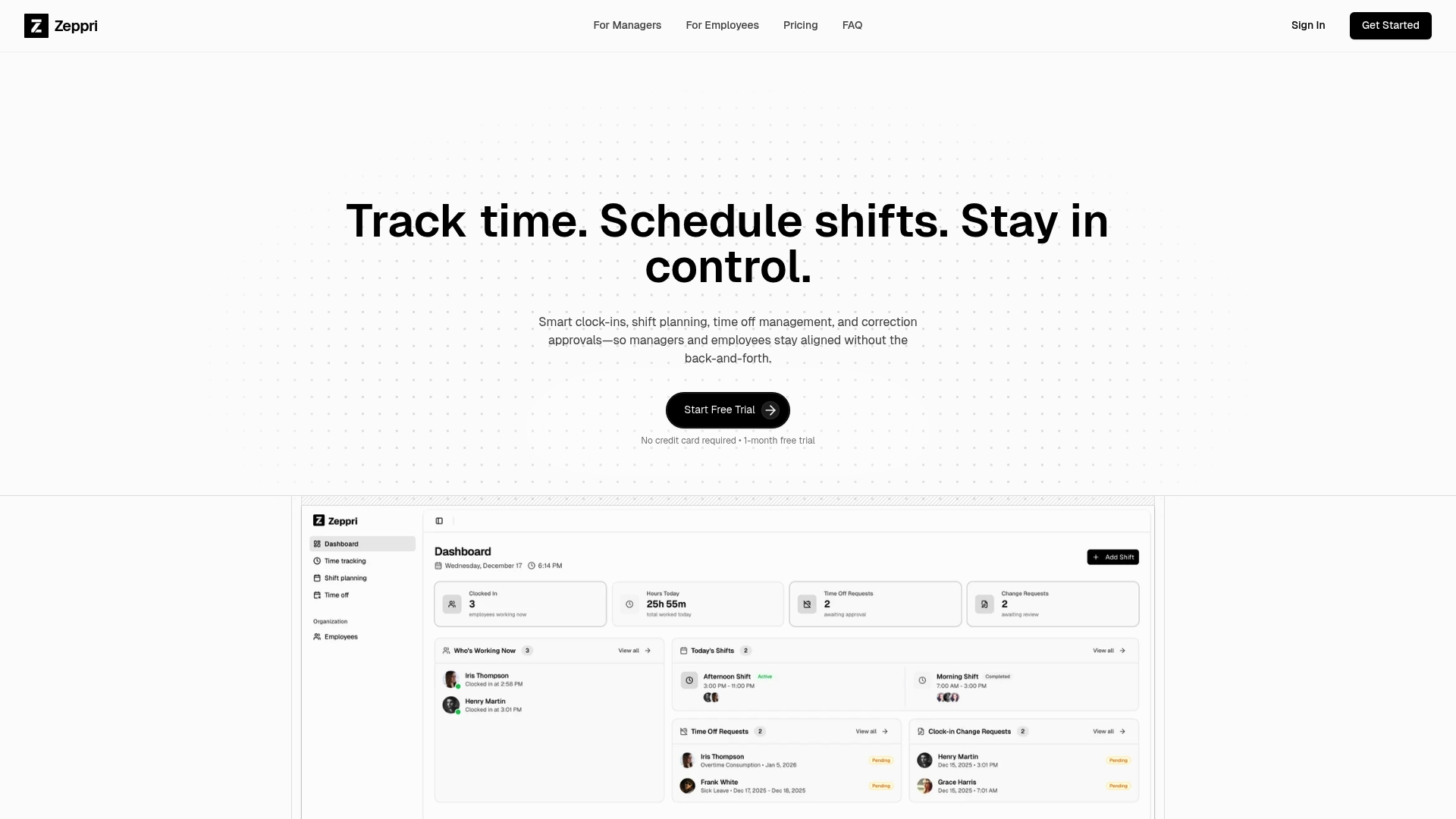
Zeppri brings all of this together in one intuitive platform built for organizations of every size. From real-time clock-ins and geofencing to automated reporting and shift planning, time tracking with Zeppri gives HR managers and team leaders exactly what they need to run a compliant, productive, and people-first operation. Explore Zeppri today and see how straightforward modern workforce management can be when everything works together from day one.
Frequently asked questions
How does automated time tracking improve payroll accuracy?
Automated systems eliminate manual data entry, which is the leading source of payroll errors. Precise records reduce errors by up to 80%, cutting disputes and speeding up payroll cycles significantly.
Can automated time tracking work for remote and hybrid teams?
Absolutely. Modern platforms offer cloud-based dashboards and mobile access so managers and employees can log and review time from anywhere. Real-time visibility aids oversight across distributed teams without requiring physical presence.
Does automated tracking hurt employee trust or morale?
Not when it is introduced transparently and used to support rather than surveil. Risks to morale exist only when tracking feels punitive. Clear communication and employee access to their own data keep morale intact.
Is automated time tracking only for large organizations?
No. Teams of any size benefit from the accuracy, compliance support, and time savings automation provides. Real-time visibility aids oversight in small organizations just as effectively as in large ones, especially when schedules vary.