

TL;DR:
- Workforce management integrates operational efficiency with employee experience, affecting productivity and morale.
- Modern WFM uses technology like AI and mobile apps for real-time, proactive management.
- Effective WFM fosters trust, engagement, and compliance, delivering measurable business and employee benefits.
Most leaders assume workforce management is just a fancy term for scheduling shifts or trimming labor costs. It's not. True workforce management (WFM) sits at the intersection of operational efficiency and employee experience, touching everything from real-time attendance tracking to long-term compliance strategy. Get it right, and you'll see measurable gains in productivity, retention, and morale. Get it wrong, and you'll spend your days firefighting avoidable scheduling gaps, compliance risks, and disengaged teams. This guide breaks down exactly what WFM is, what it looks like in practice, and how you can start building a system that works for your business and your people.
Table of Contents
- Understanding workforce management: The essentials
- Traditional vs. modern approaches to workforce management
- Core components of effective workforce management
- Benefits of workforce management for businesses and employees
- Key steps to implementing workforce management
- Rethinking workforce management: Our lessons from the field
- Transform your workforce with modern tools
- Frequently asked questions
Key Takeaways
| Point | Details |
|---|---|
| WFM definition | Workforce management means efficiently organizing and supporting your staff for both business results and employee well-being. |
| Modern approach | The best WFM balances technology with a focus on fairness, compliance, and employee engagement. |
| Key benefits | Effective WFM delivers lower costs, greater productivity, and happier teams. |
| Getting started | Begin with clear needs assessment, use smart tools, and build your program step by step for success. |
Understanding workforce management: The essentials
Workforce management is the practice of strategically coordinating your employees' time, skills, and schedules to meet business goals while supporting their well-being. It is not the same as workforce planning, which focuses on long-term talent forecasting and organizational design. WFM operates in the short to medium term, handling the day-to-day mechanics that keep your business running.
For HR professionals and business owners, WFM is the engine behind operational consistency. Whether you run a retail store, a hospital, or a manufacturing facility, the same core challenges apply: getting the right people in the right place at the right time, without burning through your labor budget or burning out your staff.
The key pillars of a solid WFM system include:
- Employee scheduling: Building and maintaining shift coverage that aligns with demand
- Time and attendance tracking: Capturing accurate clock-in and clock-out data
- Compliance management: Staying within labor laws, overtime rules, and industry regulations
- Labor cost control: Monitoring hours and pay to avoid budget overruns
- Employee well-being: Ensuring fair scheduling, adequate rest periods, and manageable workloads
Effective WFM also makes efficient shift scheduling much simpler, because you're working from a structured system rather than reactive guesswork.
Workforce management is more than daily scheduling. It is both an operational discipline and a direct contributor to employee experience, shaping how people feel about their work and their employer.
This expanded definition matters. If you treat WFM as a cost-cutting tool alone, you'll miss half its value.
Traditional vs. modern approaches to workforce management
With the basics established, it's important to recognize how workforce management has changed over time.
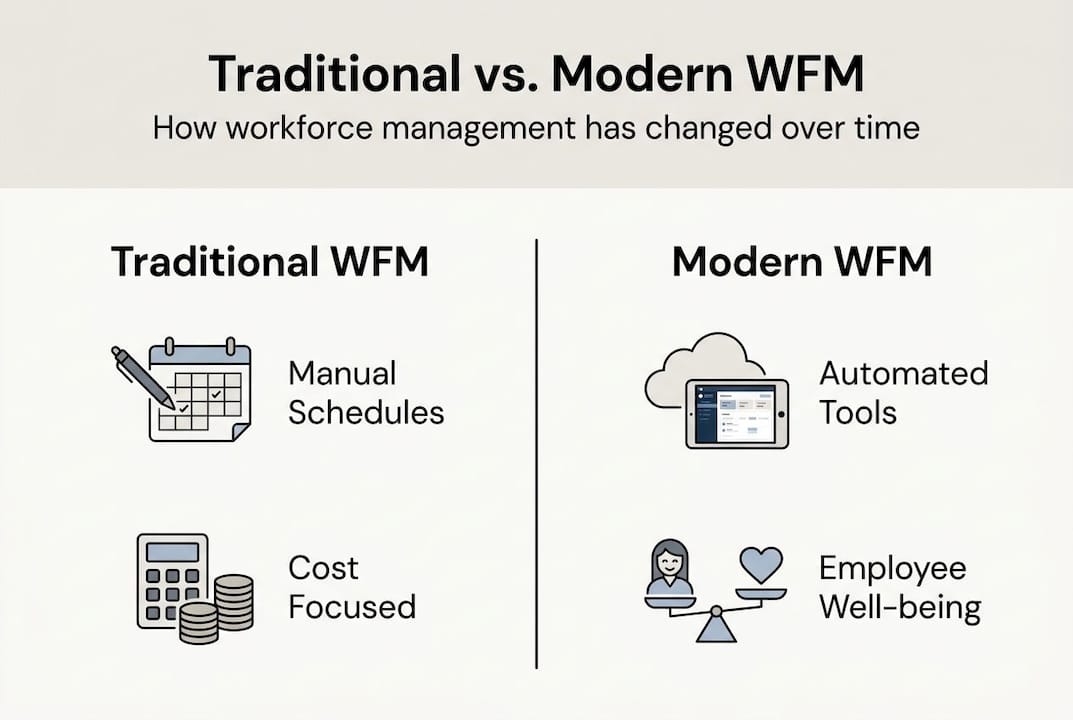
Traditional WFM was largely manual and heavily cost-focused. Managers built schedules on spreadsheets, tracked hours with paper timesheets, and measured success by whether labor costs stayed under budget. Employee preferences? Often an afterthought. Compliance? Something you handled reactively when an audit appeared.
Modern WFM looks fundamentally different. Today's approach balances operational efficiency with employee fairness, legal compliance, and a strong focus on the overall work experience. Technology drives most of this shift. Mobile apps, AI-assisted scheduling, and cloud-based platforms make it possible to manage teams in real time across multiple locations.

| Factor | Traditional WFM | Modern WFM |
|---|---|---|
| Primary focus | Cost reduction | Efficiency + employee experience |
| Tools | Spreadsheets, paper | Mobile apps, AI software |
| Compliance approach | Reactive | Proactive, automated |
| Employee input | Minimal | Self-service, transparent |
| Data use | Limited reporting | Real-time analytics |
The shift toward centralized schedule management has been one of the most impactful changes for mid-size organizations. Instead of siloed managers making isolated decisions, leadership gets a single source of truth for all scheduling and attendance data.
Pro Tip: Don't sacrifice operational efficiency for employee satisfaction or vice versa. The best WFM systems give you tools to achieve both simultaneously, not trade one for the other.
Core components of effective workforce management
To fully appreciate these differences, let's break down the core components of a robust workforce management program.
Each component serves a distinct function, but they work together as an integrated system:
- Employee scheduling: Assigns the right staff to the right shifts based on availability, skills, and demand forecasts. Smart scheduling reduces overtime, prevents understaffing, and improves service quality.
- Time and attendance tracking: Records when employees start and finish work, capturing breaks and overtime accurately. Understanding time tracking basics is essential before selecting any WFM platform.
- Compliance management: Monitors labor law requirements, break rules, maximum hours, and mandatory rest periods. Strong workforce compliance strategies protect your business from costly penalties.
- Analytics and reporting: Turns raw attendance and scheduling data into actionable insights. You can spot patterns in absenteeism, identify overstaffed periods, and plan better for peak seasons.
The benefits of automated time tracking are significant here. Automation eliminates manual entry errors, speeds up payroll processing, and frees managers to focus on people rather than paperwork.
The technology shift is real and accelerating. Manual spreadsheets are giving way to AI and math-optimization tools that can generate schedules in seconds, flag compliance risks automatically, and provide instant visibility across your entire workforce. Organizations that stick with manual processes are not just slower. They're operating with a structural disadvantage.
Benefits of workforce management for businesses and employees
Armed with a detailed understanding of WFM components, let's see how they drive measurable results.
Modern workforce management aims for both efficiency and improved employee experience, and the data backs this up. Businesses that implement structured WFM systems report faster payroll cycles, fewer compliance incidents, and better budget predictability. Employees report more equitable schedules, less burnout, and higher job satisfaction.
| Impact area | Business benefit | Employee benefit |
|---|---|---|
| Scheduling | Lower overtime costs | Fair, predictable shifts |
| Attendance | Accurate payroll data | Transparent timekeeping |
| Compliance | Fewer legal penalties | Protected rights and rest periods |
| Analytics | Smarter resource allocation | Recognition of reliable performance |
Some quick wins organizations see after WFM adoption:
- Reduced time spent building and adjusting schedules each week
- Fewer no-shows due to automated reminders and self-service swap requests
- Faster payroll processing from integrated time data
- Improved manager visibility into staffing gaps before they become problems
- Higher employee engagement scores in team surveys
Industries like hospitality are seeing particularly strong results. Exploring how WFM drives efficiency and well-being in fast-paced environments shows just how transformative a structured approach can be. And with mobile apps reshaping how teams connect, employees now have real-time access to their schedules, time-off requests, and shift swaps from any device.
The bottom line: WFM is not a cost center. It's a revenue enabler when managed well.
Key steps to implementing workforce management
Now you're convinced of the value. Here's how to bring efficient workforce management into your organization.
- Assess your current state: Audit how scheduling, time tracking, and compliance are handled today. Identify the biggest pain points, whether that's overtime overruns, missed breaks, or payroll errors.
- Evaluate WFM tools: Look for platforms that address your specific needs. Consider ease of use, mobile access, integration with payroll systems, and scalability as your team grows.
- Run a pilot program: Start with one department or location. This reduces risk and gives you real data on what works before a company-wide rollout.
- Onboard thoroughly: Train managers and employees together. Adoption fails when only leadership understands the system. Mobile clock-in best practices are a great starting point for getting your team comfortable quickly.
- Review and adjust: Set a 30, 60, and 90-day review cadence. Use analytics to measure improvements, identify gaps, and refine your processes continuously.
The most common pitfall? Trying to implement everything at once. Organizations that roll out WFM in phases see significantly better adoption rates and fewer integration headaches. Transitioning from spreadsheets to AI-enhanced WFM solutions brings significant efficiency gains, but only if the transition is managed thoughtfully.
Pro Tip: Start with your most scheduling-intensive team. Quick wins there build internal momentum and make it easier to expand WFM across your entire organization.
Ongoing training matters just as much as initial setup. Processes evolve, regulations change, and new employees need guidance. Build a rhythm of regular check-ins and data reviews to keep your WFM system sharp.
Rethinking workforce management: Our lessons from the field
Before you launch your own WFM strategy, consider this perspective based on hard-won experience.
Most organizations approach WFM with one question: how do we reduce labor costs? It's an understandable instinct. But organizations that lead with cost-cutting often create a second, more expensive problem: disengaged employees.
Here's what most leaders overlook. When employees feel their schedules are arbitrary, their time is not respected, or their preferences are invisible to management, they disengage. Disengagement shows up as absenteeism, high turnover, and declining performance. Each of those costs far more than any scheduling efficiency gain.
Think of WFM like infrastructure maintenance. You can defer it to save money short term, but the long-term cost of collapse is much higher than consistent upkeep. The same logic applies to your workforce.
The organizations that get the most from WFM treat it as a tool for building trust, not just tracking time. They use mobile engagement insights to connect with employees in real time, give people visibility into their own data, and create systems that feel fair. That investment pays back in retention, loyalty, and a team that actually wants to show up.
Transform your workforce with modern tools
Ready to experience these benefits? Discover the tools that make workforce management seamless.
Zeppri is built for exactly the challenges you've been reading about. From real-time mobile clock-ins to automated scheduling, geofencing, and built-in compliance tracking, Zeppri gives HR professionals and business owners a single platform to manage their entire workforce without spreadsheet chaos.
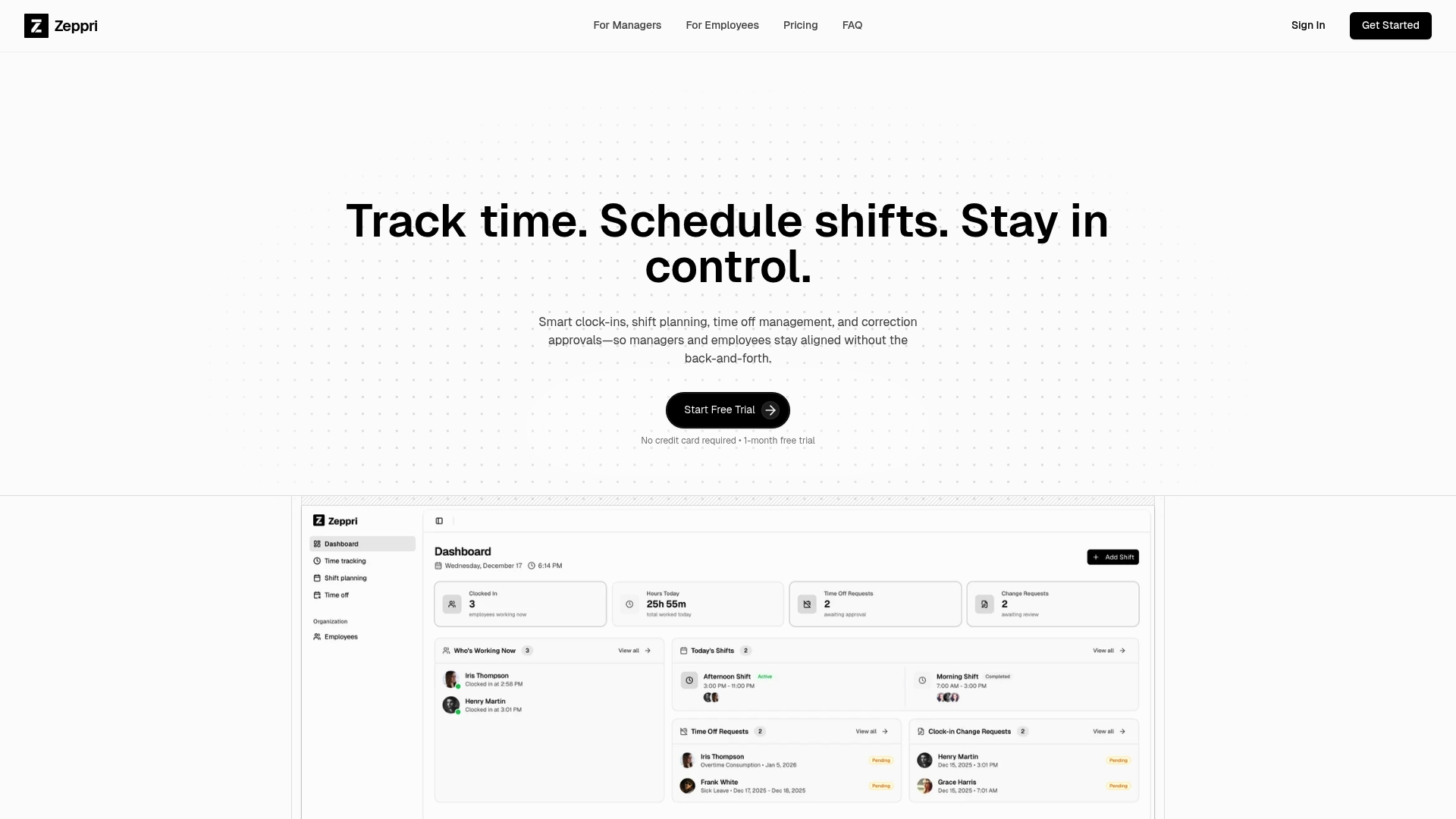
Whether you're a retail manager juggling shift swaps or an HR leader overseeing hundreds of employees across locations, Zeppri's workforce management solutions are designed to scale with you. Quick onboarding, transparent pricing, and intuitive dashboards mean your team is up and running fast. Take the next step toward smarter, fairer, and more efficient workforce management today.
Frequently asked questions
What is workforce management and why is it important?
Workforce management is the process of optimizing scheduling, attendance, and compliance to boost both operational efficiency and employee experience. It matters because poorly managed workforces cost businesses money, increase compliance risk, and drive employee disengagement.
How does workforce management software improve business results?
WFM software automates complex tasks like scheduling and compliance tracking, saving managers significant time and reducing costly errors. Manual processes are being replaced by AI-powered tools that provide real-time insights and drive measurably better outcomes.
What is the difference between workforce management and workforce planning?
Workforce management handles daily operations like scheduling, attendance, and compliance, while workforce planning focuses on longer-term staffing strategy, headcount forecasting, and organizational design. Both matter but serve different time horizons.
How can small businesses benefit from WFM solutions?
Small businesses gain immediate advantages including tighter labor cost control, simplified compliance, and more equitable scheduling. Modern WFM emphasizes fairness and a better employee experience regardless of organization size, making it just as valuable for a 10-person team as for a 1,000-person operation.