

TL;DR:
- Real-time attendance tracking provides instant data, improving accuracy, compliance, and resource management.
- It reduces administrative workload, payroll errors, and enhances employee accountability and trust.
- Successful implementation depends on transparency, consent, and fostering a culture of fairness over surveillance.
Manually chasing timesheets, correcting payroll errors, and piecing together who showed up for which shift puts HR professionals in a constant reactive mode. When your attendance data is always a day or a week behind, you're managing the past instead of steering the present. Real-time attendance tracking changes that dynamic completely, giving operations managers and HR teams the accurate, immediate data they need to make smarter workforce decisions, stay compliant, and build the kind of transparent workplace culture that actually keeps employees engaged.
Table of Contents
- What is real-time attendance tracking and why does it matter?
- Top real-time attendance tracking benefits for your organization
- Mitigating risks: Ensuring transparency, accuracy, and consent
- Comparing real-time and traditional attendance tracking methods
- Is real-time tracking right for everyone? Situational recommendations
- The uncomfortable truth: Technology alone doesn't build trust or performance
- Next steps: Streamline your attendance tracking with Zeppri
- Frequently asked questions
Key Takeaways
| Point | Details |
|---|---|
| Administrative efficiency | Real-time tracking streamlines approval processes and cuts payroll errors. |
| Compliance support | Automated, up-to-date records help organizations stay audit-ready. |
| Transparency is key | Clear communication and employee consent are vital for program success. |
| Consider organization fit | Evaluate your team's needs to decide if real-time tracking is appropriate. |
| Technology isn’t a cure-all | Lasting improvements require combining digital tools with people-first leadership. |
What is real-time attendance tracking and why does it matter?
Real-time attendance tracking is the practice of capturing and surfacing employee clock-in and clock-out data the moment it happens, rather than batching it for later review. Instead of waiting until the end of a pay period to find out that someone was consistently late or that a shift was uncovered, managers see that information instantly through a live dashboard.
Traditional approaches rely on paper sign-in sheets, manual spreadsheets, or even basic badge scanners that export data in bulk. These systems create a lag between what's happening on the floor and what managers actually know. That gap causes payroll errors, compliance gaps, and frustration on both sides of the manager-employee relationship. A good manager's guide to time tracking will tell you that the single biggest inefficiency in most workforce operations isn't the process itself. It's the delay between data collection and visibility.
Real-time tracking matters for three core reasons:
- Compliance: Labor laws require accurate records of hours worked. Real-time data makes it easy to document overtime, breaks, and schedule adherence without scrambling at audit time.
- Efficiency: Managers can reassign staff or call in coverage immediately when gaps appear, rather than discovering the problem hours later.
- Morale: Employees who know the system is accurate are less likely to dispute their hours, and less likely to feel unfairly monitored.
That last point is where things can go wrong if you're not careful.
"Real-time tracking reduces admin time but risks privacy invasion and trust erosion if not handled transparently. There's also potential bias in AI and biometric systems, and serious legal risks without proper consent. The focus should always be on trends, not individuals." AT&T's attendance tracking misstep highlights exactly how badly this can go when organizations prioritize surveillance over trust.
The AT&T case is a telling example. Their monitoring program generated real data, but the approach created distrust and resentment rather than accountability. Real-time tracking is only as good as the culture and communication surrounding it.
Top real-time attendance tracking benefits for your organization
Having established the concept and context, let's look at the concrete advantages organizations experience with real-time tracking when it's implemented thoughtfully.
-
Reduced administrative burden: HR teams spend far less time chasing attendance records, resolving payroll disputes, and correcting timesheet errors. Automated systems log data instantly, which means your payroll runs faster and with fewer mistakes.
-
Fewer payroll errors: Manual entry is one of the biggest sources of payroll inaccuracy. When clock-in data flows directly into your payroll system without human rekeying, you eliminate that error point entirely.
-
Stronger compliance posture: Real-time data gives you an always-current paper trail. Whether it's proving break compliance, overtime eligibility, or simply verifying that scheduled shifts were covered, your documentation is ready the moment you need it.
-
Better resource allocation: When you can see live staff coverage across locations or departments, you can move people to where they're needed. A retail manager who sees a slow-developing coverage gap in the afternoon can address it before the lunch rush ends, not after.
-
Greater accountability without surveillance overreach: When employees know that a fair, transparent system is tracking their time, it naturally encourages punctuality and reduces unplanned absenteeism. This only works, however, when staff understand exactly what is being tracked and why.
Understanding the automated time tracking benefits goes beyond payroll savings. Organizations that use real-time data well report improved shift coverage, better communication between managers and teams, and fewer last-minute staffing crises.
One thing that often surprises HR teams is how much mobile clock-in accuracy improves accountability at the employee level. When workers use a mobile app to clock in rather than a shared terminal, the data is tied to their specific device and, in many cases, verified by GPS location. That specificity eliminates buddy punching (where one employee clocks in on behalf of another) and gives managers confidence that records are genuine.

Pro Tip: Before rolling out any real-time tracking system, hold a team meeting to explain exactly what data is collected, how it's used, and who can see it. Employees who feel informed are dramatically more likely to embrace the system, and you'll avoid the trust erosion that derailed AT&T's monitoring program rollout.
Mitigating risks: Ensuring transparency, accuracy, and consent
Of course, while the benefits are significant, so are the potential downsides, especially if trust and legal basics are overlooked.
Privacy and consent are non-negotiable. Many jurisdictions require explicit employee consent before you can collect biometric data or use location tracking. Failing to get that consent doesn't just create a trust problem. It creates a legal liability. As the AT&T case demonstrated, legal risks without consent can be serious and expensive, even when the underlying tracking system works exactly as intended.
Here's a practical checklist for building a risk-conscious rollout:
- Write a clear data policy: Document what data you collect, how long you keep it, who has access, and how it's secured. Make this available to all employees before the system goes live.
- Collect written consent: For any biometric or location-based tracking, document employee consent individually. Generic policy agreements are often insufficient.
- Establish a dispute resolution process: Employees should have a clear, simple way to flag a discrepancy in their records and have it reviewed promptly.
- Audit your system for bias: AI-powered or biometric systems can produce inaccurate results for certain demographic groups. Test your system and monitor outcomes.
- Limit access to sensitive data: Not every manager needs to see everything. Role-based access controls keep personal data protected and reduce misuse risk.
"When transparency and consent are afterthoughts, even a technically excellent tracking system will fail. Employees don't resist data. They resist surveillance."
Strong compliance management strategies always put communication at the front of the implementation plan, not at the end. The organizations that execute tracking rollouts most successfully treat the human conversation as the actual work, and the technology as the tool.
Pro Tip: Involve a small cross-functional group of employees, including frontline workers, in your pilot launch. Their feedback will surface usability problems early and, more importantly, signal to the broader workforce that their voices matter in how the system is designed. Good mobile clock-in best practices almost always involve this kind of early employee engagement.
Comparing real-time and traditional attendance tracking methods
Armed with risk mitigation strategies, you may still wonder how real-time solutions stack up against the old ways.
| Feature | Real-time tracking | Traditional/manual tracking |
|---|---|---|
| Data speed | Instant | Hours to days |
| Payroll accuracy | High | Moderate to low |
| Compliance documentation | Automatic | Manual compilation |
| Manager visibility | Live dashboard | Periodic reports |
| Employee dispute resolution | Data available immediately | Often delayed |
| Setup and training | Moderate upfront | Low upfront, high ongoing |
| Scalability | Easily scalable | Difficult beyond small teams |
The AT&T case is instructive here, too. Their system generated data, but inaccuracies led to frustration and damaged morale rather than improving it. The table above shows the technical advantages of real-time tracking, but technology that employees don't trust produces bad data or gaming of the system. Both outcomes are worse than no system at all.
There are situations where manual tracking still has a role:
- Very small teams: A team of five or six people with stable schedules may not generate enough complexity to justify the investment.
- Highly autonomous roles: Knowledge workers or senior staff who manage their own time often respond negatively to minute-by-minute tracking.
- Transitional periods: During system migrations or technology outages, manual backup processes remain essential.
For most organizations managing shift-based work, field teams, or multiple locations, real-time tracking wins on virtually every practical dimension. The key to making centralizing schedule management work is choosing a platform that makes the live data easy to act on, not just easy to collect.
Is real-time tracking right for everyone? Situational recommendations
After seeing the comparison, the key question is: should your team make the switch, or stick with what's working?
The answer depends on your workforce structure, your industry, and honestly, your organizational culture. Here's how different scenarios map to real-time tracking value.
| Workforce type | Real-time tracking fit | Primary benefit |
|---|---|---|
| Retail/hospitality | Very high | Coverage visibility, overtime control |
| Healthcare/clinical | Very high | Compliance, credential-linked shift records |
| Manufacturing/logistics | High | Safety compliance, accurate shift data |
| Field/mobile teams | High | Location verification, accurate hours |
| Remote knowledge workers | Moderate | Project time tracking, flexible check-ins |
| Small office teams | Low to moderate | Useful if payroll complexity exists |
For roles involving direct customer contact, physical safety protocols, or regulated environments like healthcare, the compliance case for real-time data is essentially unanswerable. For creative or autonomous professional roles, the calculus shifts.
The important principle, borrowed from the AT&T lesson, is to focus on trends not individuals. Real-time data is most valuable when it informs scheduling decisions, identifies systemic patterns, and flags compliance risks at the team or department level. Using it to micromanage individual employees creates resentment and drives the exact disengagement you're trying to prevent.
Here's a four-step framework for deciding if real-time tracking fits your needs:
-
Map your biggest operational pain point: Is it payroll accuracy, coverage gaps, compliance documentation, or absenteeism? Real-time tracking solves all of these, but identifying your primary driver helps you evaluate tools accurately.
-
Assess your workforce composition: Shift-based, field-based, and multi-location workforces gain the most. Knowledge-worker teams gain less from constant tracking and may react poorly to it.
-
Evaluate your current compliance risk: If you're in a regulated industry or have had audit issues, real-time records offer significant protection.
-
Consider your culture's readiness: Teams with a history of poor communication or low trust will need a deliberate rollout plan. Teams with strong communication can move faster.
Exploring mobile workforce management tips can help you think through how mobile-first tools support the specific needs of field teams and frontline workers who benefit most from these systems.
The uncomfortable truth: Technology alone doesn't build trust or performance
Here's the perspective most vendor articles won't give you: the biggest risk in any attendance tracking initiative isn't the technology failing. It's the organization succeeding at collecting data while failing at everything else.
AT&T's monitoring experience is a perfect case study. The system worked. It produced data. What it didn't produce was trust, buy-in, or the behavioral improvements that supposedly justified the investment. The lesson isn't that tracking is bad. The lesson is that a tracking program designed primarily around oversight will generate resistance, while a program designed primarily around fairness and clarity will generate support.
We've seen this pattern repeatedly. Organizations that lead with "we're going to monitor you more closely" create defensive cultures. Organizations that lead with "we're fixing a system that was unfair, inaccurate, and frustrating for everyone" create buy-in. Real-time attendance tracking should feel like a relief to employees, not a threat. When they can see their own records, resolve disputes with actual data, and trust that overtime is being calculated correctly, they stop worrying about the system and start focusing on their work.
The deeper truth is that performance doesn't improve because you're watching people more carefully. It improves when people understand expectations, feel fairly treated, and have the tools to do their jobs well. Technology is an enabler of that environment, not a substitute for it. We've written about this connection between efficiency and well-being insights in the hospitality context, but the principle applies everywhere.
Real-time data is incredibly powerful in the hands of a manager who uses it to coach, support, and plan. In the hands of a manager who uses it to catch and punish, it becomes a morale liability. The tool is neutral. The leadership approach is everything.
Next steps: Streamline your attendance tracking with Zeppri
The principles in this article, accuracy, transparency, consent, and smart data use, don't have to be theoretical. You can build all of them into your workforce operations starting now.
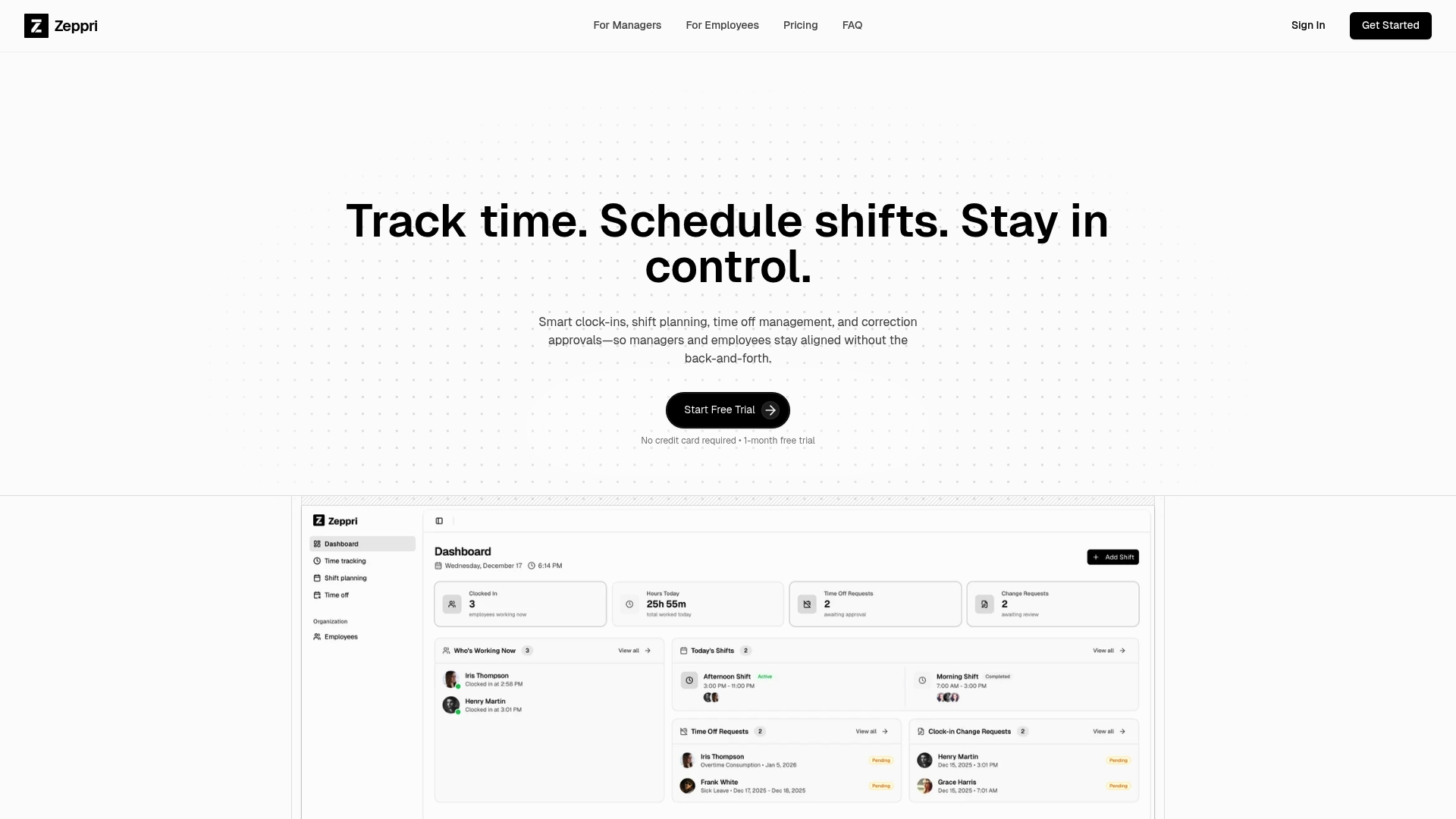
Zeppri is built specifically for organizations that want real-time attendance tracking without the surveillance baggage. The platform offers mobile clock-ins with geofencing, live manager dashboards, automated time-off management, and detailed reporting tools that make compliance straightforward. Employees get full visibility into their own records through a clean mobile app, which is one of the simplest ways to build the transparency that drives adoption. Whether you're managing a retail team across multiple locations or coordinating field staff, Zeppri time tracking gives you the live data you need while keeping your team informed and in control of their own information.
Frequently asked questions
What are the biggest drawbacks of real-time attendance tracking?
The main drawbacks are privacy risks and trust erosion when transparency and consent are missing, plus potential legal liability if your data collection isn't properly disclosed to employees.
How does real-time attendance tracking help with compliance?
It creates an always-current, accurate record of hours worked, breaks taken, and shifts covered, giving you the documentation you need for labor audits and overtime compliance without last-minute scrambling.
Can real-time systems replace all manual attendance processes?
Not entirely. Most organizations still benefit from manual backup procedures for technology outages, highly autonomous roles, or very small teams where the complexity doesn't justify the tooling investment.
How can organizations ensure employee buy-in for new tracking systems?
Transparent policies and clear consent practices are the foundation. Involving employees early in the rollout and giving them access to their own data removes the surveillance feel and replaces it with a sense of fairness.