

TL;DR:
- Disengagement causes operational issues like high turnover and scheduling chaos, not just morale problems.
- Workforce Engagement Management integrates tools and processes to build genuine employee engagement through operational practices.
- Effective engagement measurement combines real-time operational data with continuous feedback and managerial oversight.
Only 21% of employees globally are engaged at work, and most HR leaders treat that as a morale problem. It isn't. Disengagement is an operational crisis that shows up in missed shifts, high turnover, poor customer service scores, and scheduling chaos that costs real money. This guide cuts through the noise to give HR professionals and workforce management leaders a clear, practical framework for understanding what engagement actually means in your operational context, how to measure it honestly, and how to convert data into actions that move the needle on both people outcomes and business results.
Table of Contents
- Defining employee engagement in workforce management
- How engagement is operationalized: Workforce engagement management (WEM)
- Measuring engagement: Effective practices for HR and operations
- Role of managers: The engagement multiplier and risk factor
- From numbers to action: Applying engagement insights for results
- The real challenge: Engagement is an operational system, not an HR exercise
- Empower your workforce: Smarter engagement and management solutions
- Frequently asked questions
Key Takeaways
| Point | Details |
|---|---|
| Engagement is operational | Employee engagement directly affects how work gets done, not just how people feel at work. |
| Managers drive results | Enabling and supporting managers has a bigger impact than any single HR program or tool. |
| Measure beyond surveys | Effective engagement tracking blends surveys with operational and real-time feedback. |
| Act on what matters | Translating insights into timely changes in scheduling, feedback, and workflow is critical for progress. |
Defining employee engagement in workforce management
Engagement is one of those terms that gets used constantly and defined poorly. At its core, employee engagement reflects an employee's emotional connection and commitment to the organization, shaping how they think, feel, and act at work. That definition matters because it ties engagement directly to behavior, not just sentiment. An engaged employee doesn't just feel good about their job. They show up on time, put in discretionary effort, communicate issues early, and actively support their team's goals.
In workforce management, engagement manifests in very concrete ways. Engaged employees follow scheduling protocols, submit accurate time records, flag problems before they escalate, and adapt when operational needs shift. Non-engaged employees do the minimum. Actively disengaged employees actively undermine the work around them, whether by spreading frustration to colleagues, calling out without notice, or ignoring shift requirements entirely.
Here's how the current global breakdown looks:
| Engagement Level | Global Share | Operational Impact |
|---|---|---|
| Actively engaged | 21% | High productivity, low absenteeism |
| Not engaged | 62% not engaged | Coasting, minimal effort |
| Actively disengaged | 17% | Absenteeism, conflict, turnover |
"Engagement is not a perk program. It's the daily behavioral contract between an employee and their work. When it breaks down, operations feel it before HR does." This framing is what separates organizations that use engagement data strategically from those that file survey results and forget them.
For medium to large organizations, the stakes scale fast. A 500-person retail operation with 62% non-engaged staff isn't facing a culture problem in the abstract. It's facing thousands of unproductive hours per week, elevated turnover costs, and scheduling volatility that cascades into customer experience failures. Understanding how mobile apps and engagement connect helps bridge the gap between measuring sentiment and improving daily operational behavior.
How engagement is operationalized: Workforce engagement management (WEM)
Knowing what engagement means is only half the problem. The harder part is building systems that actually produce it. That's where Workforce Engagement Management, commonly called WEM, comes in. WEM integrates employee experience initiatives with scheduling, feedback, quality assurance, and voice-of-the-employee tools into a unified operational framework. It's the bridge between HR strategy and day-to-day workforce operations.
Think of WEM as the practical machinery behind engagement theory. It includes tools and processes like fair, transparent scheduling systems, quality assurance reviews, structured coaching conversations, peer recognition programs, and formal channels for employee feedback. Without these operational levers, engagement remains aspirational rather than actionable.
Here's how traditional workforce management compares to engagement-centered WEM:
| Dimension | Traditional WM | Engagement-Centered WEM |
|---|---|---|
| Scheduling | Efficiency-driven only | Balances efficiency with fairness and preference |
| Feedback | Annual reviews | Continuous, structured coaching |
| Employee voice | Suggestion boxes, rarely acted on | Integrated listening tools with visible follow-through |
| Manager role | Task overseer | Engagement multiplier and coach |
| Technology | Clock-in, time tracking | Real-time analytics, self-service, communication tools |
The key operational levers in WEM include:
- Scheduling transparency: Employees who understand how shifts are assigned and have some input into their schedules show measurably higher commitment.
- Quality assurance feedback: Regular, specific performance feedback tied to observed behavior improves both skill and motivation.
- Employee voice tools: Formal, acted-on channels for raising concerns build trust faster than any morale initiative.
- Manager coaching: Structured one-on-ones and feedback conversations directly increase reported engagement scores.
One fact that surprises many leaders: managers account for 70% of the variance in team engagement. That means your best WEM technology is only as good as the managers deploying it. Giving managers the right mobile app features to oversee schedules, communicate in real time, and track team performance is not a convenience upgrade. It's an engagement strategy.
Pro Tip: Don't treat engagement as a standalone HR initiative. Every operational decision, from how shifts are built to how time-off requests are handled, is an engagement event. Embedding engagement thinking into mobile clock-in best practices is a practical starting point for connecting daily operations to engagement outcomes.
Measuring engagement: Effective practices for HR and operations
Most organizations measure engagement wrong. They run an annual survey, wait three months for results, share a dashboard with the leadership team, and then wait another year to see if scores improved. That cycle is almost guaranteed to fail because engagement is dynamic. It shifts week to week based on schedule fairness, manager interactions, workload, and operational frustrations that no annual survey captures in time to act on.
Effective engagement measurement blends operational data with ongoing employee listening programs. Here's a practical framework for building a measurement program that actually works:
- Run pulse surveys monthly or quarterly. Short, focused surveys of five to eight questions capture real-time sentiment before problems calcify into turnover.
- Track operational signals alongside survey data. Absenteeism rates, voluntary overtime uptake, schedule adherence, and time-off request frequency are all engagement proxies hidden inside your operational data.
- Build feedback loops, not feedback events. Every listening exercise should have a visible response. Employees who see their input acted on are significantly more likely to engage in future surveys and to report problems early.
- Segment by team and manager, not just company-wide. Aggregate scores hide the real story. A company-wide engagement score of 65% can mask a single department sitting at 30%, dragging turnover and absenteeism for the whole operation.
- Set a review cadence with your frontline managers. Monthly check-ins on engagement signals, not just operational KPIs, keep managers accountable and informed.
Combining automated time tracking benefits with engagement data gives HR leaders a more complete picture. When you can see that one shift cluster has significantly higher unplanned absences and lower schedule adherence, and then cross-reference that with pulse survey scores for the same group, you've moved from guessing to diagnosing.

Pro Tip: Use "stay interviews" alongside your standard surveys. Ask engaged employees what keeps them. The answers reveal what to protect. Ask employees who recently submitted time-off requests for unusual reasons what drove it. The answers reveal what to fix before it becomes a resignation.
Role of managers: The engagement multiplier and risk factor
Every engagement strategy eventually runs through a manager. Manager enablement is key, because managers account for the majority of the variance in workforce engagement and are themselves increasingly at risk of disengagement. This creates a compounding problem that many organizations overlook entirely.
As organizations flatten and middle managers absorb broader spans of control, the administrative burden on those managers grows significantly. When managers spend their energy on manual scheduling, chasing down time records, and managing compliance paperwork, they have less capacity for the coaching, recognition, and communication that actually drive team engagement. The result is a manager engagement decline that drags down the employee experience across every team they touch.
What makes this particularly risky is that disengaged managers don't usually announce themselves. They quietly reduce their feedback frequency, stop following up on employee concerns, and lean harder on compliance and task management rather than people development. Their teams notice before anyone in leadership does.
Here's what effective manager support looks like in practice:
- Reduce administrative load. Managers who spend less time on scheduling logistics and manual time tracking have more bandwidth for coaching conversations.
- Provide structured coaching frameworks. Don't assume managers know how to have effective one-on-ones. Give them a format, a frequency, and a set of questions that consistently surface engagement signals.
- Monitor manager engagement separately. Include managers in pulse survey programs and track their scores alongside their teams'. A manager whose own engagement drops by 15 points in a quarter is a leading indicator, not a lagging one.
- Recognize managers publicly for engagement outcomes, not just operational metrics. If your performance reviews only track schedule adherence and overtime costs, that's what managers will optimize for.
"The manager is not a relay station for company policy. They are the living, breathing operational environment their team works inside every day. Their mood, clarity, and capacity directly shape what engagement feels like on the floor."
Using centralized schedule management tools directly reduces the administrative friction that burns out managers and leaves them with no capacity for the human side of their role.
From numbers to action: Applying engagement insights for results
Data without action is just expensive noise. The organizations that improve engagement year over year aren't the ones with the most sophisticated survey tools. They're the ones with disciplined follow-through on what the data tells them. Engagement improvement requires acting on data with fair scheduling, effective feedback, and eliminating operational bottlenecks that frustrate employees before they even have a chance to disengage.
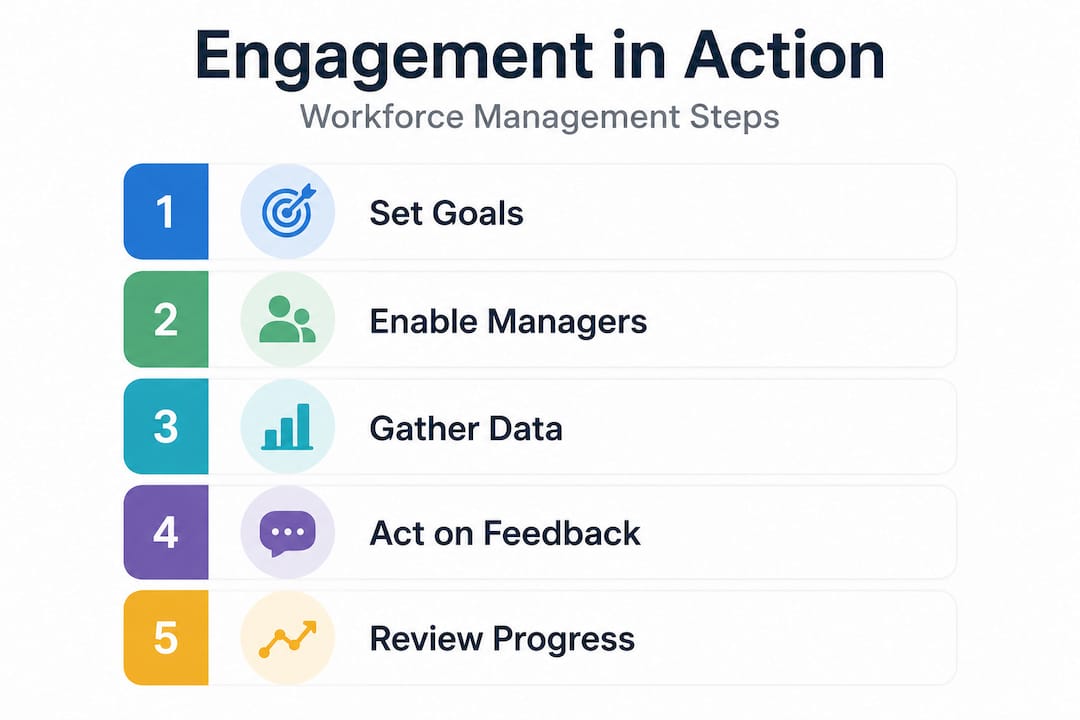
Here's a practical sequence for converting engagement insights into operational results:
- Identify your highest-friction operational moments. Use your operational data and survey responses together to pinpoint where engagement drops. Is it during specific shift patterns? After scheduling changes? Following certain management interactions?
- Prioritize fair scheduling as a first fix. Scheduling that feels arbitrary or inconsistent is one of the fastest drivers of disengagement. Employees who experience fair, predictable scheduling report higher engagement even when other factors remain unchanged.
- Build regular feedback into the operational rhythm. Not a once-a-quarter meeting, but a weekly or biweekly brief check-in that addresses workload, blockers, and recognition. Frequency matters more than formality.
- Create visible channels for employee voice and close the loop fast. When an employee raises a concern through any channel, make sure a response arrives within 48 hours. Even if the answer is "we're still working on it," the response itself signals that voice has value.
- Fix the workflow problems, not just the people problems. Engagement initiatives fail when they ignore operational realities like decision rights and coordination breakdowns. If employees can't get approvals they need or can't access the information required to do their jobs, no amount of morale investment fixes that.
Focusing on well-being focused management as an integrated operational approach, rather than a standalone wellness program, closes the gap between measuring engagement and actually improving it.
The real challenge: Engagement is an operational system, not an HR exercise
Here's the uncomfortable truth most engagement programs avoid: the majority of engagement initiatives fail not because the surveys are poorly designed or the training is inadequate, but because they're treated as HR exercises rather than operational systems. Engagement initiatives become "feel-good" unless they address decision rights and operational dysfunction at their root.
We've seen this pattern repeatedly. An organization invests in a pulse survey platform, shares the results at an all-hands meeting, launches an employee recognition program, and then watches turnover stay flat or climb. Why? Because the real engagement killers, scheduling unpredictability, unclear decision authority, manager overload, and unresolved workflow friction, were never touched.
The most successful organizations treat engagement as a living operational system with feedback loops at every level. They integrate compliance and strategy into their engagement design, recognizing that when employees feel protected, informed, and supported by consistent processes, engagement follows as a natural outcome rather than a campaign result.
The contrarian view worth taking seriously: stop asking "how do we improve engagement scores?" and start asking "what operational experiences are producing disengagement, and how do we redesign them?" That shift in framing moves engagement from a sentiment project to a systems improvement effort, which is where durable results actually live.
Pro Tip: Build a quarterly engagement operations review that includes HR, operations leadership, and frontline managers. Review survey data alongside operational signals, assign owners to specific friction points, and track resolution. Treat it like a product backlog, not a feelings discussion.
Empower your workforce: Smarter engagement and management solutions
Workforce engagement doesn't improve in theory. It improves when you have the right tools, processes, and visibility in place to act on what your data tells you, every day, at every level of the organization. The framework in this guide gives you the "what" and "why." The next step is having a platform that delivers the "how" at scale.
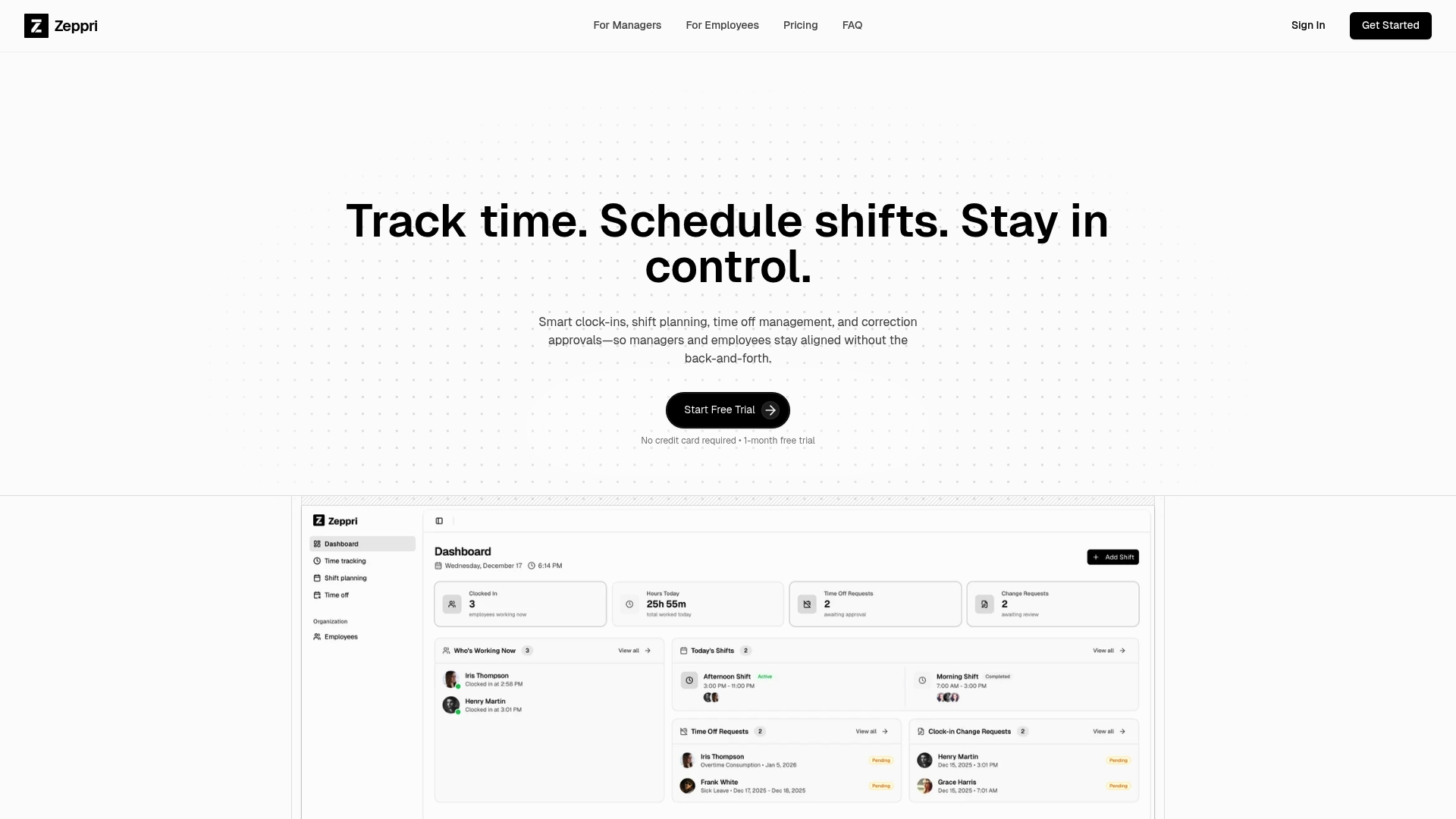
Zeppri is built for exactly this challenge. The platform unifies scheduling, time tracking, real-time attendance, automated time-off management, and mobile-first employee access in a single environment that gives managers the visibility they need and employees the self-service experience that builds trust. With geofencing, real-time analytics, and streamlined reporting, Zeppri turns operational data into engagement-relevant insights your teams can act on immediately. Explore what Zeppri for workforce management can do for your engagement and efficiency goals, and see how a connected workforce platform changes what's possible for your teams.
Frequently asked questions
What is employee engagement in workforce management?
Employee engagement in workforce management means the emotional commitment employees show toward their organization and its goals, shaping how they feel, think, and perform at work. It goes beyond satisfaction to describe active, behavioral investment in work outcomes.
How can workforce engagement be measured effectively?
Leaders should combine operational data with regular employee listening programs, including pulse surveys, stay interviews, and ongoing feedback loops, to get a full, real-time picture of engagement across teams.
What role do managers play in employee engagement?
Managers have the most direct influence on engagement, with 70% of variance in team engagement attributable to management quality and behavior, making manager enablement a top priority for any engagement strategy.
Why do some engagement programs fail to improve results?
Programs often fall short when they focus only on survey scores and morale campaigns while ignoring operational dysfunction and decision rights that create the friction driving disengagement in the first place.