

TL;DR:
- Clear, written policies with defined leave types, request procedures, and blackout dates prevent confusion.
- Digital tools with automation and calendar integration improve tracking accuracy and team visibility.
- Fostering fairness, transparency, and proactive planning builds trust and reduces unplanned absences.
Managing time-off requests sounds simple until you're juggling a holiday rush, three overlapping vacation requests, and a team member out sick with no backup plan. For HR managers and team leads in small to mid-sized organizations, time-off management sits at the crossroads of legal compliance, employee satisfaction, and operational continuity. Real-time integrations with calendars and communication tools have become essential for visibility across distributed teams. This article breaks down 10 practical, evidence-backed tips to help you take control of time-off management without burning out your HR team or frustrating your employees.
Table of Contents
- Establish clear time-off policies
- Leverage digital tools for efficient tracking
- Encourage proactive planning and shift coordination
- Foster a culture of fairness and open communication
- Why time-off management is about more than policies and tools
- Streamline your time-off management with Zeppri
- Frequently asked questions
Key Takeaways
| Point | Details |
|---|---|
| Clear policies | Transparent and structured time-off rules support compliance and fairness for all employees. |
| Digital automation | Leveraging modern tools streamlines leave tracking and boosts organizational visibility. |
| Proactive scheduling | Planning ahead and coordinating shifts minimizes workflow disruptions and absenteeism risks. |
| Fairness and communication | Open, equitable processes build trust, increase morale, and reduce conflicts about leave. |
Establish clear time-off policies
Every effective time-off program starts with a written policy. Not a verbal agreement, not a general understanding, but an actual documented policy that every employee can access and reference. Without it, you're setting yourself up for inconsistent decisions, employee grievances, and potential legal headaches.
A strong policy covers more than just how many vacation days someone gets. It should clearly define every type of leave your organization recognizes. Think paid time off (PTO), sick leave, bereavement leave, jury duty, parental leave, and any state or federal-mandated leave types. Legal and regulatory factors heavily influence how these leave categories must be tracked and administered, so alignment with local law is not optional.
Beyond defining leave types, your policy needs to address four key operational components:
- Request protocols: How should employees submit a time-off request? Via an app, email, or a paper form? Define the process clearly so there's no ambiguity.
- Approval timelines: How long does a manager have to respond? Two business days? Five? Set expectations on both sides.
- Advance notice requirements: For planned leave, how far in advance must requests be submitted? Two weeks is a common standard, though busy seasons may require more.
- Blackout dates: Are there periods when time off is restricted due to business demand, like year-end closings or peak retail seasons? Spell those out explicitly.
When you build these elements into a single, readable document, you reduce confusion and protect the organization from complaints about favoritism. Employees appreciate knowing the rules apply equally to everyone.
"A well-written time-off policy doesn't just protect the business. It signals to employees that the organization respects their time and takes fairness seriously."
One area organizations often overlook is how to make the policy easy to understand. Legal language is necessary for compliance strategies, but it shouldn't be the only version employees see. Consider creating a simplified one-page summary that covers the most common scenarios. This is especially valuable for onboarding.
Pro Tip: Create a short FAQ specifically for new hires that answers the five most common time-off questions. Post it in your HR portal or team wiki. It saves your HR team from answering the same questions repeatedly and helps new employees feel confident navigating the system from day one.
Leverage digital tools for efficient tracking
Once your policy is written, the next challenge is actually managing requests efficiently. If you're still tracking time off in a spreadsheet or on paper, you're working harder than you need to. Manual tracking leads to errors, missed requests, and real frustration when two people are approved for the same critical week.
Automated time tracking dramatically improves accuracy and reduces administrative time, especially when your team is distributed across multiple locations or working hybrid schedules.

Here's a quick comparison of manual versus digital tracking to illustrate the difference:
| Feature | Manual tracking | Digital tools |
|---|---|---|
| Real-time updates | No | Yes |
| Employee self-service | No | Yes |
| Calendar integration | No | Yes |
| Automated approvals | No | Yes |
| Error rate | High | Low |
| Visibility for managers | Limited | Complete |
The gap is significant. Digital tools don't just reduce errors. They give employees direct visibility into their own balances and the team calendar, which means fewer back-and-forth questions to managers.
Key features to look for in a digital time-off management tool:
- Request automation: Employees submit requests through an app or portal, and the system routes them to the right manager automatically.
- Calendar sync: Approved time off shows up on team calendars so everyone can see who is out on any given day.
- Mobile access: Employees shouldn't need to be at a desktop to check their balance or submit a request. Mobile app features designed for managers and employees alike make this seamless.
- Notifications: Automatic alerts via email or messaging platforms keep both the requester and the manager informed at every step.
For hybrid and remote teams, calendar and communication integrations solve one of the most persistent visibility problems. When a teammate is out and nobody on the Slack channel knows it, coordination breaks down fast.
Pro Tip: Choose a tool that lets employees see not just their own balance, but also the team availability calendar. When employees can see that three colleagues are already off the same week, many will proactively choose different dates, saving managers from difficult conversations.
Encourage proactive planning and shift coordination
Even with great policies and tools in place, unplanned absences are one of the most disruptive forces in workforce management. A last-minute call-out during a busy shift doesn't just affect productivity. It affects morale for the employees left scrambling to cover.
The productivity impact of unplanned absences is real. Studies show absenteeism rates in the U.S. average around 3 to 4 percent of total scheduled work time, and a significant portion of that is avoidable with better planning on both sides.
Centralized schedule management gives managers a single source of truth for who is available, who is scheduled, and where coverage gaps exist. Without centralization, you're piecing together information from different systems or, worse, relying on memory.
Here's a practical look at how absenteeism affects different team sizes:
| Team size | Avg. absenteeism rate | Est. lost hours/month | Impact on coverage |
|---|---|---|---|
| 10 employees | 3.5% | ~14 hours | 1 to 2 uncovered shifts |
| 25 employees | 3.5% | ~35 hours | 3 to 4 uncovered shifts |
| 50 employees | 3.5% | ~70 hours | 6 to 8 uncovered shifts |
These numbers add up fast. The key to reducing them is a combination of policy, culture, and practical scheduling habits.
Best practices for proactive leave and shift coordination:
- Set advance notice deadlines: Require planned leave requests at least two weeks in advance, or longer for peak periods.
- Assign backup roles: For every critical position or shift, identify a trained backup before the absence happens, not after.
- Cross-train employees: The more versatile your team is, the easier it is to cover gaps. Cross-training reduces single points of failure.
- Enable shift swapping: Let employees swap shifts with manager approval through your scheduling tool. This empowers teams to solve coverage issues themselves.
- Use coverage templates: Build out template schedules for common scenarios, like one person out in a specific role, so managers aren't starting from scratch every time.
The shift scheduling guide approach emphasizes working ahead, not reacting. When managers know two weeks out that a shift needs covering, they have options. When they find out the morning of, they don't.
Foster a culture of fairness and open communication
Here's a truth that doesn't get enough attention: even the best time-off policy will fail if managers apply it inconsistently. Employees notice when certain colleagues seem to always get their preferred vacation days while others are consistently denied. That perception of unfairness is one of the fastest ways to erode team trust.
Workforce well-being improves measurably when employees feel the system is fair and that managers communicate openly about decisions. This is not just a morale issue. It affects retention, engagement, and even absenteeism rates.
Building a culture of fairness around time-off management means being intentional about every step of the approval process. Here are four concrete strategies:
- Use a first-come, first-served rotation for high-demand dates. When multiple people want the same popular week, a transparent rotation system based on who requested first, or who missed out last year, removes the perception of favoritism.
- Always explain denials. A rejection without context feels personal. A brief explanation, such as "We already have two people out that week and can't reduce coverage further," shows employees the decision is business-driven.
- Collect anonymous feedback on the process. Twice a year, ask employees to anonymously rate how fair and transparent the time-off approval process feels. You'll surface issues you might never hear about otherwise.
- Revisit the policy when patterns emerge. If the same types of requests are consistently denied or approved, that's data. Use it to refine the policy rather than ignoring the signal.
"Employees who feel heard and treated fairly are significantly more likely to give advance notice of absences and work constructively within team scheduling constraints."
Managers should also model the communication they expect from their teams. That means being responsive to requests, following up on pending decisions within the promised window, and never leaving an employee guessing about the status of their leave request. Open communication is a two-way commitment.
Why time-off management is about more than policies and tools
Most articles on this topic will tell you to digitize your processes and write a better policy. Both are useful. But they stop short of the bigger picture.
The organizations that truly master time-off management don't just have great software or airtight handbooks. They've built cultures where employees plan ahead because they trust the system, where managers respond consistently because expectations are clear, and where the whole team understands that leave management is a shared responsibility, not just an HR function.
A manager's efficiency guide reinforces something we've seen play out across industries: the biggest driver of low absenteeism isn't enforcement. It's trust. When people feel secure enough to plan their time off in advance, and confident their requests will be handled fairly, they behave differently. They communicate earlier. They arrange coverage. They return from leave recharged rather than resentful.
The challenge we'd put to HR managers and team leads is this: don't measure your time-off program only by the numbers. Yes, track your absenteeism rate. Yes, audit your approvals for consistency. But also ask whether your employees feel the process is fair, whether managers feel equipped to make decisions, and whether your culture supports honest conversations about scheduling needs. Those qualitative signals matter just as much as the data.
Streamline your time-off management with Zeppri
Managing time-off effectively doesn't have to mean more spreadsheets, more back-and-forth emails, or more administrative headaches for your HR team.
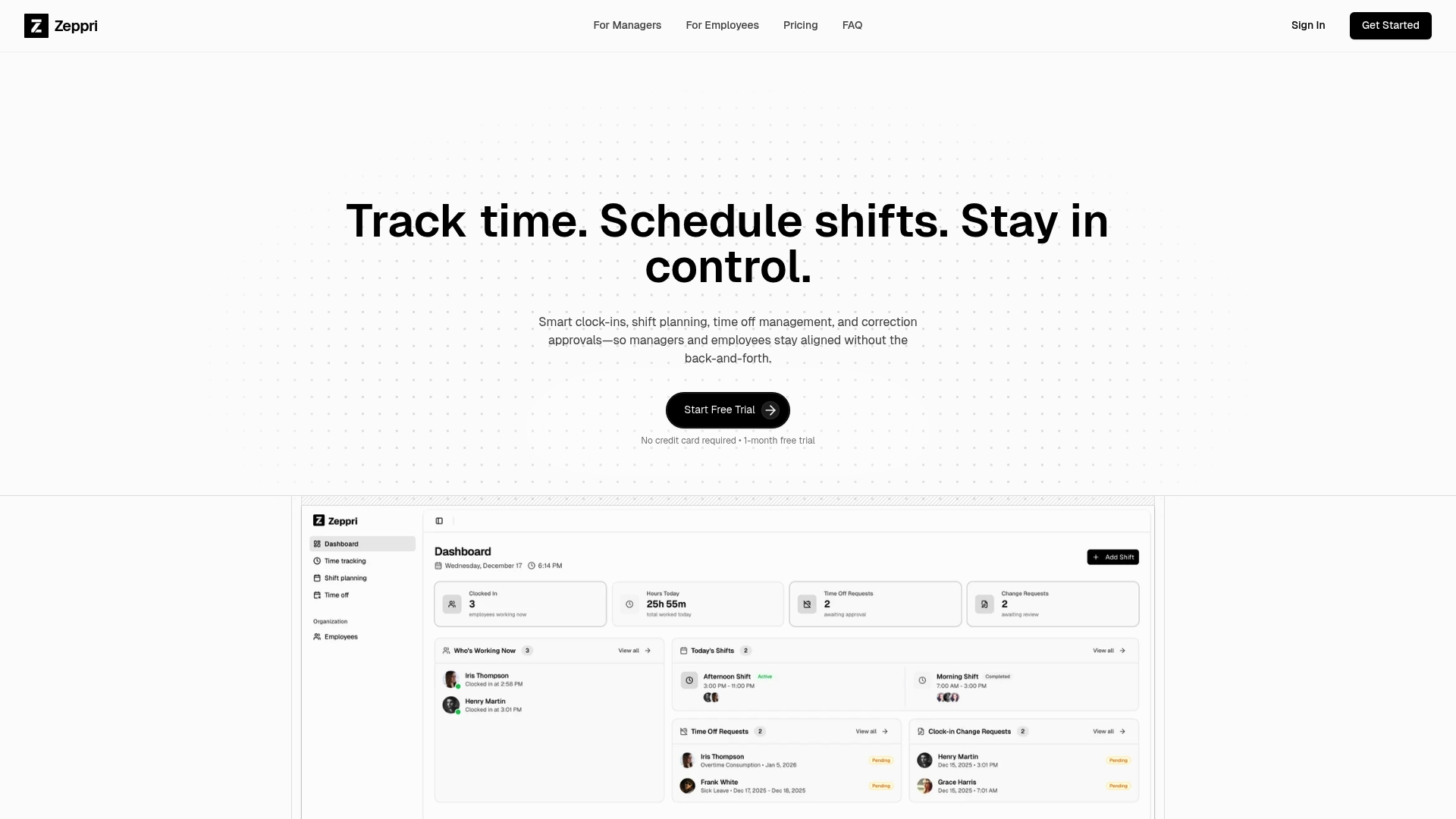
Zeppri brings together everything covered in this article, from automated leave requests and real-time team calendars to mobile self-service and manager dashboards, into a single platform built for organizations like yours. With workforce management tools designed for clarity and compliance, you can set up fair policies, give employees visibility into their own balances, and keep your scheduling running smoothly even during the busiest seasons. If you're ready to replace reactive time-off chaos with a proactive, transparent system, Zeppri is built to get you there without a steep learning curve.
Frequently asked questions
How do I handle time-off requests during busy periods?
Set clear blackout dates in your written policy before the busy season begins, rotate approvals fairly across the team, and communicate request deadlines well in advance so employees can plan around them.
What should I include in a time-off policy?
Your policy should list every type of leave your organization offers, how employees submit requests, how managers make approval decisions, submission deadlines, and any restricted dates. Legal compliance factors should inform each of these sections to ensure your policy meets regulatory requirements.
Why is digital tracking better than spreadsheets or paper?
Digital tools provide real-time balance updates, automatic notifications, and complete visibility for both managers and employees, which means far fewer errors and faster resolution of scheduling conflicts. Automated tracking also gives distributed teams the transparency they need to coordinate effectively without manager intervention at every step.
How can we make time-off approvals feel fair to everyone?
Apply consistent approval criteria to every request regardless of who submitted it, always provide a brief reason for any denial, and gather anonymous employee feedback at least twice a year to identify where the process feels uneven. Workforce well-being research consistently shows that perceived fairness in HR processes is a stronger predictor of engagement than the specific policy details themselves.