

TL;DR:
- Managing employee schedules across growing teams is complex due to last-minute changes, varying labor costs, and location-specific compliance. Selecting a user-friendly platform with automation, mobile support, and strong integration helps streamline scheduling while maintaining managerial control and employee autonomy. Effective implementation and training are crucial, as adoption drives success more than feature richness alone.
Managing employee schedules across a growing team is genuinely hard work. Between last-minute shift swaps, mounting time-off requests, fluctuating labor costs, and compliance requirements that shift by location, HR professionals and managers often spend hours every week just keeping the schedule from falling apart. The right scheduling system changes that equation entirely, turning reactive firefighting into proactive planning. This guide walks you through how to evaluate your options, profiles the leading platforms, and gives you a clear comparison to help you find the fit that actually works for your organization.
Table of Contents
- How to evaluate scheduling systems
- Popular scheduling systems for SMBs
- Scheduling systems comparison table
- Situational recommendations: Which system fits your needs?
- Beyond the features: What actually moves the needle in workforce scheduling
- Elevate your scheduling with modern workforce tools
- Frequently asked questions
Key Takeaways
| Point | Details |
|---|---|
| Prioritize fit over features | Choose a scheduling system that matches your unique HR challenges, not just the one with the most features. |
| Automation needs oversight | Automating schedules saves time but must be paired with clear policies and human review. |
| Self-scheduling boosts retention | Allowing employees to manage shifts within set rules can raise satisfaction and reduce turnover. |
| Pilot before rollout | Test new scheduling systems on a small scale to catch hidden workflow issues early. |
How to evaluate scheduling systems
Having set out to solve common scheduling headaches, let's clarify what makes a scheduling system effective before we move to examples.
Every organization comes to scheduling software with a different set of problems. Before you start demoing platforms, you need to articulate your specific pain points. Are you constantly managing shift swaps? Is time-off approval a manual mess? Are labor costs creeping up because of overtime that nobody caught in time? Pinning down your top two or three challenges gives you a filter for every platform you evaluate.
Once you know your problems, you can apply a consistent set of evaluation criteria. Here are the factors that matter most:
- Usability: Can frontline managers build and publish a schedule in under 15 minutes? Complex tools with steep learning curves often get abandoned after the first month.
- Automation: Does the platform auto-assign shifts based on availability, role, and hours caps? Automation reduces admin burden significantly, but as scheduling research shows, it still needs human oversight to handle local nuances like union rules or team-specific preferences.
- Integrations: Does the system connect with your payroll provider, HR information system, or POS? Data silos add work, not remove it.
- Mobile support: Frontline employees live on their phones. A system without a solid mobile app will face immediate pushback.
- Scalability: Can the platform handle 20 employees today and 200 next year without requiring a complete system overhaul?
- Cost: Monthly per-user pricing models can sneak up on you as headcount grows. Get clarity on all tiers before signing.
One often overlooked factor is employee self-scheduling. Giving staff the ability to pick up open shifts or swap within approved parameters does more than reduce admin workload. Research consistently links employee autonomy in scheduling to higher retention rates. When employees feel heard, they stay longer. That said, self-scheduling only works when the system enforces your rules automatically, so managers aren't cleaning up policy violations after the fact. The key is finding the balance between optimizing workforce scheduling and keeping managers in control of critical decisions.
Another important consideration is how centralization affects your team's efficiency. Organizations that use fragmented tools, such as a spreadsheet for scheduling and a separate app for time-off, end up doing double the data entry. The schedule centralization benefits of a unified platform are real and measurable, from fewer errors to faster approvals and cleaner payroll data.
Pro Tip: Before you commit to any platform, run a two-week pilot with your core scheduling managers and a small cross-section of employees. Real-world use exposes friction that a polished demo never will. Look specifically at how quickly managers build schedules and how employees respond to the mobile experience.
Popular scheduling systems for SMBs
Now that we know what to look for, let's see which scheduling systems actually stand out and why.
According to a detailed market review, popular SMB scheduling tools include Homebase, When I Work, 7shifts, Deputy, Connecteam, Rippling, Gusto, Agendrix, HotSchedules, and Humanity Schedule. Each serves different use cases, so let's look at the ones most relevant to HR professionals managing hourly and shift-based teams.
Homebase is a strong choice for small retail and food service businesses. It offers a generous free tier for single-location teams, and its scheduling, time tracking, and basic HR tools are tightly bundled. The interface is clean enough that non-technical managers pick it up quickly. Homebase is particularly good for teams under 50 employees who need everything in one place without a high price tag.
When I Work is a reliable option for businesses that need strong shift communication alongside scheduling. Its standout feature is the built-in team messaging, which keeps all shift-related conversations on one platform instead of floating around in text threads. Restaurant chains, retail groups, and small healthcare clinics have used it successfully to reduce no-shows and miscommunication.
Deputy has broader appeal for organizations scaling past 100 employees. It handles complex compliance requirements well, including break rules and overtime thresholds, making it a smart pick for companies operating in multiple states or countries. Deputy's AI-powered demand forecasting also helps managers align staffing levels with expected foot traffic or production demand.
Rippling sits a level above the others in terms of integrated HR capability. It combines scheduling with a full HRIS, payroll, and benefits management. For companies that want to consolidate HR tech stacks, Rippling is worth the premium. However, smaller teams may find it overpowered for their needs, and the implementation process requires more upfront time.
HotSchedules (now part of Fourth) is specifically built for hospitality and food service. Its labor forecasting and scheduling tools are deeply tailored to restaurant operations, making it the go-to for multi-unit restaurant groups or hotel chains. If your workforce is entirely in hospitality, it's difficult to beat.
If you're exploring alternatives to other tracking tools, it's also worth checking out top Apploye alternatives that bundle scheduling with time tracking and payroll in a way that suits small and mid-sized teams.
Pro Tip: Look for platforms that have dedicated onboarding resources for new HR users, not just general tutorials. When I Work and Homebase both offer onboarding checklists and live support that accelerate adoption for teams new to scheduling software.
Scheduling systems comparison table
Individual platform strengths matter, but direct comparison can clarify which system is best for your context.
Use this table to quickly assess how the five platforms stack up across criteria that HR professionals care about most. Keep in mind that pricing tiers vary, so always confirm current rates directly with each vendor.
| Platform | Starting price | Automation level | Employee self-service | Mobile app quality | Best for |
|---|---|---|---|---|---|
| Homebase | Free (1 location) | Moderate | Yes, with manager approval | Strong | Small retail or food service |
| When I Work | ~$2.50/user/mo | Moderate | Yes, shift swaps + open shifts | Excellent | Team communication focus |
| Deputy | ~$4.50/user/mo | High | Yes, with rule-based controls | Strong | Multi-location or compliance-heavy |
| Rippling | Custom pricing | Very high | Yes, full self-service | Good | Full HR integration needs |
| HotSchedules | Custom pricing | High | Yes, shift bidding | Strong | Hospitality and food service |
A few key takeaways from the comparison. Homebase wins on entry-level accessibility and price. When I Work wins on communication features. Deputy wins for compliance automation. Rippling wins for businesses that want scheduling as part of a complete HR platform. HotSchedules wins when you're running a restaurant or hotel operation where labor forecasting is tied directly to revenue.
The goal isn't to find the most feature-rich platform. It's to find the one that solves your specific problems without requiring your managers to navigate unnecessary complexity. A scalable workforce scheduling guide can help you think through the feature set that genuinely matters at your current stage of growth versus what you're just paying for.
Situational recommendations: Which system fits your needs?
Now let's make sense of the comparison by matching systems to specific workforce challenges.
Choosing the right tool depends heavily on your industry, team structure, and the specific pain points you identified in your evaluation phase. Here's how to match your situation to the right platform.

Retail teams with multiple locations: Deputy or When I Work. Both handle multi-location visibility well, and Deputy's compliance automation is particularly useful for retailers navigating varied state labor laws. Shift swapping is clean and manager-approved in both platforms.
Restaurant and hospitality operations: HotSchedules or Homebase. HotSchedules offers industry-specific labor forecasting that few other platforms match. For smaller independent restaurants, Homebase's free tier and intuitive interface often cover 90% of what's needed.
Remote or professional office teams: Rippling or When I Work. Remote teams have very different scheduling needs, mostly centered around time zone awareness, meeting coordination, and project-based shift tracking. Rippling's full HR integration works well here. When I Work also adapts to office environments when team communication and availability tracking are priorities.
High-turnover environments: Homebase or When I Work. Fast onboarding for new employees is critical in high-turnover settings. Both platforms allow new staff to set up their profiles and start picking shifts quickly, reducing the admin burden on HR when headcount fluctuates constantly.
Compliance-heavy industries (healthcare, logistics): Deputy. Its automated break enforcement, overtime alerts, and multi-jurisdiction support make it the strongest choice when regulatory compliance is non-negotiable. Healthcare schedulers particularly value its ability to track certifications and required qualifications alongside shift assignments.
When deciding which features are essential versus optional, a useful rule of thumb is this: if a missing feature creates a compliance risk or adds more than 30 minutes of manual work per week, it's essential. Everything else is a nice-to-have.
"Automation reduces admin but needs human oversight for local nuances; self-scheduling boosts retention when rule-bound." — Shift Scheduling Insights from the Front Lines
This insight is worth keeping front of mind during your selection process. Automation is powerful. But it's only as good as the rules you build into it. If your platform can't encode your actual scheduling policies, automation will create more problems than it solves.
For a detailed walkthrough of the tactical steps involved in building efficient schedules, the efficient shift scheduling steps breakdown is a helpful practical reference to pair with your platform selection process.
Beyond the features: What actually moves the needle in workforce scheduling
Here's the uncomfortable truth most scheduling software vendors won't tell you. The platform you pick matters far less than whether your managers and employees actually adopt it. We've seen organizations invest in sophisticated scheduling tools only to watch managers default back to paper-and-pencil systems within three months. Not because the software was bad, but because no one invested in the human side of implementation.
Pilot tests expose this reality in ways that sales demos simply cannot. When you put a scheduling system in front of real users doing real work, you see exactly where they get stuck, what they avoid, and what they find genuinely helpful. Demo environments are clean, curated, and consequence-free. Actual scheduling is messy, urgent, and full of edge cases.
There's also a counterintuitive lesson about features. More features do not equal more value. In fact, overly feature-rich platforms often reduce adoption because they overwhelm both managers and employees. The best scheduling system is the simplest one that solves your actual problems. Clarity and adoption always beat feature count.
Investing in training is not optional. It's as important as the tool itself. Build feedback loops into the first 90 days. Ask managers weekly what's working and what isn't. Ask employees if they're finding the mobile app usable. The data from automated time tracking insights shows that organizations that invest equally in training and technology see significantly faster ROI from workforce management tools.
Finally, remember that scheduling is a people problem as much as it is a systems problem. Even the most automated platform will require judgment calls. Treat your scheduling system as a tool that supports decision-making, not one that replaces it.
Elevate your scheduling with modern workforce tools
Ready to put these ideas into action? Moving from spreadsheets or disconnected tools to a modern scheduling platform is one of the highest-leverage investments you can make in workforce efficiency. The right technology partner makes that transition smooth rather than stressful.
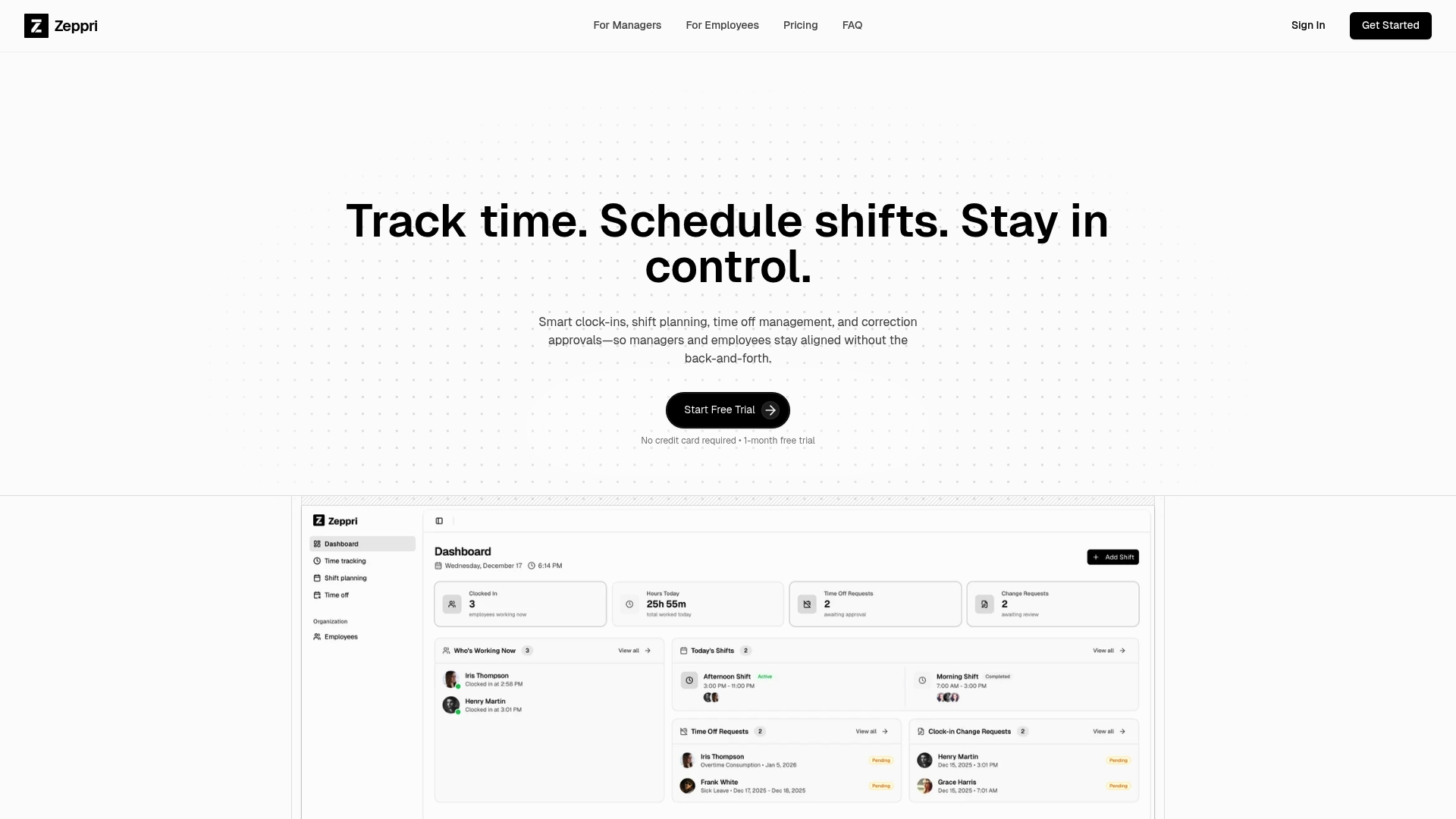
Zeppri workforce management brings together shift scheduling, real-time time tracking, geofenced clock-ins, automated time-off management, and robust reporting in a single platform built for teams of all sizes. Whether you're managing a 15-person retail team or coordinating schedules across multiple locations, Zeppri's mobile-first design and intuitive manager dashboard give your team the visibility and control they need without a steep learning curve. Transparent pricing and quick onboarding mean you're up and running fast, not stuck in a months-long implementation.
Frequently asked questions
What are the main types of scheduling systems used in small businesses?
The main types include manual spreadsheets, dedicated cloud-based tools like Homebase or When I Work, and integrated HR platforms that bundle scheduling with payroll and compliance. According to a comprehensive review of SMB scheduling tools, the market now offers options suited to virtually every industry and team size.
How does scheduling software improve workforce management?
Scheduling software automates shift assignments, centralizes communication, reduces manual errors, and flags compliance issues like overtime before they become costly problems. As front-line scheduling insights confirm, automation handles the volume while freeing managers to focus on the judgment calls that actually matter.
Does every SMB need advanced automation in their scheduling system?
Not at all. Smaller teams with predictable schedules often find basic features more than sufficient, while larger operations with shift complexity, multi-location management, or compliance requirements genuinely benefit from higher automation. Research on self-scheduling shows that even simple rule-based automation can boost retention without requiring enterprise-level tools.
What are common pitfalls when choosing a scheduling system?
The biggest pitfalls are choosing a platform based on feature count rather than fit, underestimating the importance of mobile usability for frontline staff, and skipping structured onboarding. A mismatch between your actual workflows and the system's design leads to workarounds, which defeats the purpose of adopting a scheduling tool in the first place.