

TL;DR:
- Scalable workforce management improves scheduling accuracy, compliance, and reduces administrative time.
- High-quality demand data is essential for effective scheduling and cost savings.
- Automation and real-time monitoring help SMBs handle disruptions and scale efficiently.
Labor costs can make up 20-35% of gross revenue in small and midsize businesses, yet most HR teams still rely on spreadsheets and group chats to manage their schedules. That gap between cost reality and operational chaos is where efficiency dies. Scalable workforce management closes that gap by giving HR professionals and operations managers a structured, adaptable system for scheduling, compliance, and time tracking. This guide breaks down the core pillars, walks through a practical implementation framework, and addresses the real-world challenges that derail even well-intentioned teams.
Table of Contents
- Defining scalable workforce management: Core pillars
- How SMBs implement scalable solutions: Step-by-step framework
- Optimization and automation: Driving efficiency and accuracy
- Navigating real-world challenges: Edge cases and fairness
- Our take: Why scalable workforce management is the SMB game-changer
- Connect with modern workforce management solutions
- Frequently asked questions
Key Takeaways
| Point | Details |
|---|---|
| Five pillars framework | Scalable workforce management depends on forecasting, scheduling, attendance, analytics, and compliance. |
| Best practices for SMBs | Start with demand data, use templates, and monitor real-time for efficient scaling. |
| Tech enables rapid ROI | Automation and optimization can reduce labor costs by up to 30% and pay back in less than two years. |
| Edge cases require nuance | Handling seasonality, remote teams, and fairness is key for real-world scalability. |
| Data quality is crucial | High-quality forecasts prevent failures and support accurate scheduling and compliance. |
Defining scalable workforce management: Core pillars
Scalable workforce management is not just about buying software. It means building systems that adapt as your team grows, your locations expand, or your business needs shift. When you add 20 new employees or open a second site, your processes should stretch to fit, not collapse under the pressure.
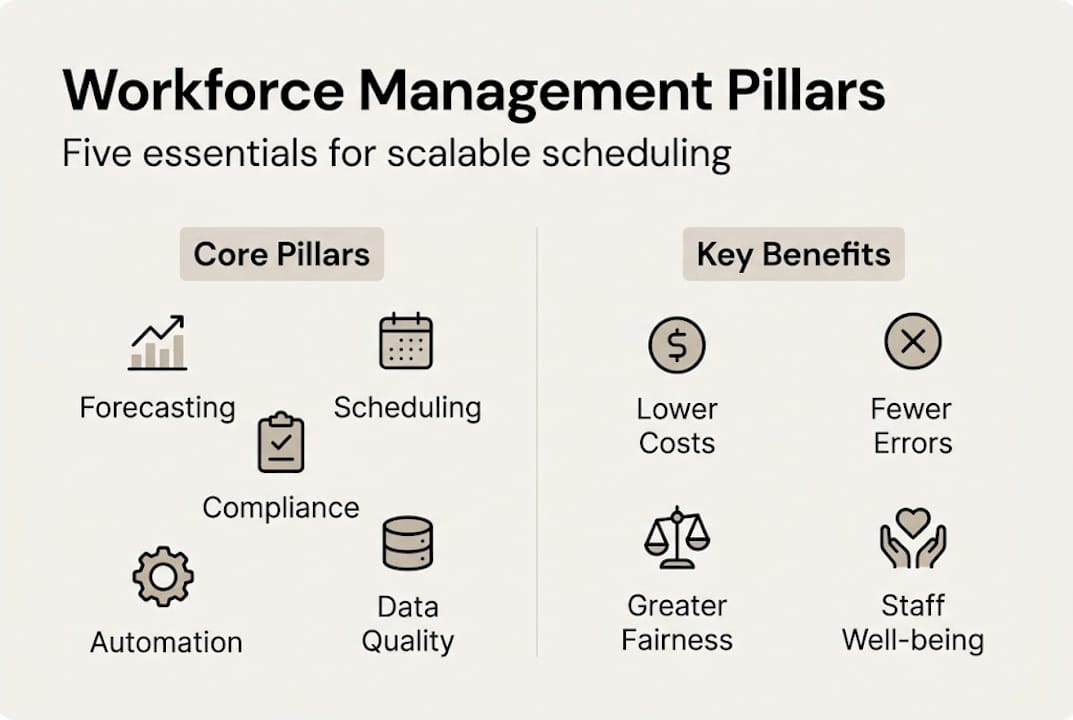
The core mechanics of a scalable system include demand forecasting, role-based scheduling, compliance tracking, time and attendance management, and real-time adjustments. These five pillars work together. Pull one out and the others start to wobble.
Here is what each pillar actually does for your organization:
- Demand forecasting: Predicts staffing needs based on sales data, foot traffic, or production volume so you are never over or understaffed.
- Role-based scheduling: Assigns shifts based on skills, certifications, and availability rather than guesswork.
- Time and attendance tracking: Captures accurate clock-in and clock-out data, reducing payroll errors and compliance risk.
- Performance analysis: Surfaces patterns in productivity, absenteeism, and overtime so managers can act on facts, not gut feelings.
- Compliance management: Automates rule enforcement for break requirements, overtime thresholds, and labor law changes across jurisdictions.
Manual processes break down fast as organizations scale. A manager handling 10 employees with a spreadsheet can just about manage. At 50 employees across two shifts, that same spreadsheet becomes a liability. Errors compound, compliance gaps widen, and your best people spend hours on administrative work instead of running operations.
| Approach | Scheduling accuracy | Compliance risk | Admin time per week |
|---|---|---|---|
| Manual spreadsheets | Low | High | 8-12 hours |
| Basic digital tools | Medium | Medium | 4-6 hours |
| Scalable WFM platform | High | Low | 1-2 hours |
The mobile app features for managers available in modern platforms make a real difference here. Real-time visibility into who is clocked in, who called out, and which shifts need coverage turns reactive firefighting into proactive management.
Statistic callout: Organizations using structured workforce management systems report dramatically lower compliance violations and administrative overhead compared to those still relying on manual methods.
How SMBs implement scalable solutions: Step-by-step framework
Understanding the core concepts, let's walk through how SMBs put scalable solutions into action with practical frameworks. The good news is that you do not need a massive IT budget or a six-month rollout to get started.
Follow this sequence to build a scheduling and compliance workflow that actually scales:
- Gather clean demand data. Pull sales reports, customer traffic logs, or production records. The quality of your forecast depends entirely on the quality of your input data.
- Set role-based staffing targets. Define how many people you need per role, per shift, and per location. Include both hard constraints (certifications required) and soft constraints (employee preferences).
- Load constraints into your system. Enter overtime rules, break requirements, and any union or regulatory obligations. Your platform should enforce these automatically.
- Build reusable schedule templates. Create templates for your most common shift patterns. This cuts scheduling time dramatically each week.
- Publish schedules early. Start with demand data, set role targets, load constraints, use templates, and publish early so employees can plan their lives and you reduce last-minute call-outs.
- Monitor in real time. Watch for gaps, tardiness, or unexpected absences as they happen so you can respond before operations suffer.
Cloud-based platforms are the backbone of this approach. A single database shared across managers, HR, and payroll eliminates the version-control nightmare of emailed spreadsheets. Integrations with your HRIS and payroll system mean data flows automatically rather than being re-entered by hand.

| Feature | Manual process | Scalable platform |
|---|---|---|
| Schedule creation | Hours per week | Minutes with templates |
| Payroll data transfer | Manual re-entry | Automated export |
| Compliance updates | Manager-dependent | System-enforced |
| Employee self-service | Phone calls or texts | App-based requests |
An efficient shift scheduling guide can help you map out the specific steps for your industry. And if you are managing multiple sites, centralized schedule management gives you a single source of truth without sacrificing local manager flexibility.
Pro Tip: Start your implementation with your highest-volume shift or most complex location. Proving value there first builds internal buy-in and surfaces edge cases before you roll out company-wide.
Optimization and automation: Driving efficiency and accuracy
With an implementation framework in place, let's examine how newer technologies and data-driven processes can supercharge efficiency and accuracy. Optimization is where good scheduling becomes great scheduling.
The quality of your demand forecast is everything. Garbage input data produces chaotic schedules, which then produce overtime violations, understaffed shifts, and frustrated employees. Invest time in cleaning your historical data before you build forecasts on top of it.
Automation handles the repetitive work so your team can focus on decisions that actually require human judgment:
- Self-service shift swaps: Employees request and confirm swaps through an app, with manager approval built in. No more text threads.
- Automated time-off requests: Employees submit requests digitally, the system checks coverage rules, and managers get a clean approval queue.
- Real-time alerts: Managers get notified when someone clocks in late, misses a shift, or approaches an overtime threshold.
- Payroll-ready exports: Time data flows directly into payroll without manual re-entry, cutting errors and processing time.
The ROI case for optimization is concrete. Structured workforce management delivers 8-15% labor cost reduction through optimization, with some organizations achieving 30% lower costs and rapid payback periods. For a business spending $500,000 annually on labor, that lower end represents $40,000 back in your budget.
The benefits of automated time tracking go beyond cost savings. Accurate records protect you in audits, reduce payroll disputes, and give managers the data they need to make smarter staffing decisions. And mobile apps for workforce management extend these capabilities to field teams, remote workers, and multi-site operations without adding complexity.
Pro Tip: Set up automated alerts for employees approaching overtime thresholds before they cross them. Preventing one overtime violation per week can save thousands annually in a mid-sized operation.
Navigating real-world challenges: Edge cases and fairness
Even the most optimized systems face unexpected obstacles. Here is how scalable workforce management helps teams overcome common and uncommon hurdles.
Seasonality is one of the biggest pressure points for SMBs. Retail operations, hospitality businesses, and event-driven industries can see staffing variance of 30-50% between peak and off-peak periods. A scalable system models these swings in advance, letting you build contingent worker pools, adjust templates, and plan hiring timelines before the rush hits.
Other real-world challenges include:
- Contingent and remote workers: Modern platforms track hours and compliance for part-time, contract, and remote employees alongside full-time staff, all in one system.
- Event-driven rescheduling: Rush orders, large bookings, or sudden absences require fast adjustments. Real-time dashboards and push notifications let managers respond in minutes, not hours.
- Multi-state compliance: Labor laws vary significantly by state and locality. Overtime rules, break requirements, and predictive scheduling laws all differ. A scalable platform enforces the right rules for each location automatically.
- Explainable scheduling decisions: When automation drives scheduling, employees want to understand why they received certain shifts. Transparent rule logic builds trust and reduces grievances.
"Balancing operational efficiency with fairness and equity is not optional. It is the difference between a workforce that trusts its management and one that quietly disengages."
The fairness dimension matters more than most guides admit. Optimized schedules that consistently favor certain employees, whether intentionally or through algorithmic bias, create resentment and turnover. Build equity checks into your process: rotate desirable shifts, honor stated preferences where possible, and give employees visibility into how decisions are made.
For teams in hospitality or service industries, staff well-being and efficiency are directly linked. Employees who feel fairly scheduled show up more reliably and perform better. That is not soft management philosophy. It is an operational outcome.
Our take: Why scalable workforce management is the SMB game-changer
Most guides focus on features and frameworks. Here is what they miss: the single biggest predictor of whether scalable workforce management delivers results is not the platform you choose. It is the quality of your demand data going in.
Data quality is foundational for scalable management. We have seen organizations invest in excellent platforms and still struggle because they fed those platforms with inconsistent, incomplete historical data. Clean your data first. Then automate.
Conventional wisdom says larger organizations benefit most from workforce management technology. We disagree. SMBs gain outsized returns because their margins are tighter and their administrative burden relative to team size is heavier. Micro-enterprise autonomy plus central visibility prevents chaos at scale without stripping local managers of the flexibility they need.
The smartest implementation move for SMBs is to start with your most exception-heavy workflows, the shifts with the most call-outs, the roles with the most compliance risk, the locations with the most overtime. Fix those first. The ROI shows up fast, and it builds the organizational confidence to expand the system further. Centralized schedule management insights show this pattern consistently across industries.
Connect with modern workforce management solutions
If the frameworks in this guide resonate, the next step is finding a platform built to handle the real complexity of SMB scheduling, compliance, and time tracking without requiring an enterprise-level IT team to run it.
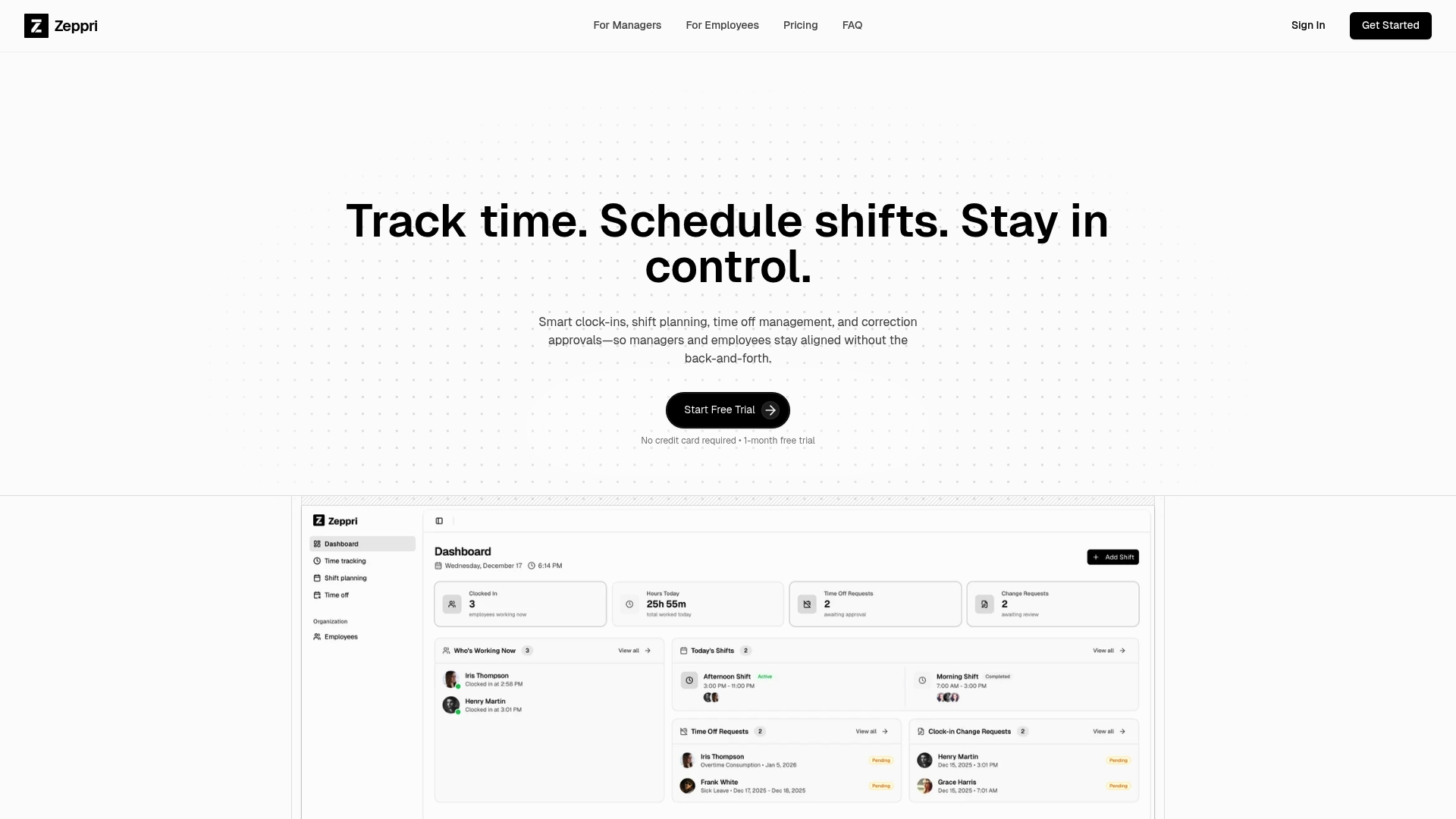
Zeppri is designed for exactly this: scalable workforce management that works for organizations from 10 to 1,000 employees. From geofenced clock-ins and automated time-off workflows to real-time manager dashboards and payroll-ready exports, Zeppri gives HR professionals and operations managers the tools to run leaner, stay compliant, and give employees a better experience. Explore how the platform fits your operation and see why teams across retail, hospitality, healthcare, and manufacturing trust it to keep their workforce running smoothly.
Frequently asked questions
What makes workforce management truly scalable for SMBs?
Scalability relies on adaptable systems, automation, and integrated data so processes adjust as organizations grow. Cloud-based platforms with a single database and payroll or HRIS integrations are the technical foundation that makes this possible.
How much can optimized workforce management reduce labor costs?
Structured workforce management can lower labor costs by 8-15% through optimization, with some organizations achieving 30% reductions and rapid payback periods depending on their starting baseline.
What's the biggest mistake SMBs make when scaling workforce management?
The top mistake is poor demand data input. Low-quality forecasts cause cascading errors across scheduling, compliance, and payroll that are far more expensive to fix than to prevent.
How do scalable systems handle seasonal and disruption-driven challenges?
They model staffing swings of 30-50%, automate event-driven rescheduling, and manage compliance rules across multiple regions and worker types within a single platform.
Is automation necessary for small organizations?
Yes. Automation for self-service swaps and real-time adjustments cuts admin time significantly, even for small teams, and creates the operational foundation needed to scale without adding headcount to HR.