

TL;DR:
- Effective time-off management improves operational continuity and employee recovery.
- Centralized approval systems and proactive planning prevent staffing gaps.
- Cultural support from leadership and fair policies increase leave utilization and employee well-being.
Most organizations treat time-off management as an afterthought, buried in an HR handbook that employees skim once during onboarding. The assumption is simple: offer generous leave, watch satisfaction soar. But the evidence tells a more complicated story. How you manage time-off shapes operational stability, employee recovery, and team performance far more than how much leave you technically offer. This guide breaks down the science, the practical frameworks, and the structural decisions that separate organizations that see real workforce gains from those that wonder why their "great" leave policies aren't moving the needle.
Table of Contents
- Operational continuity: Avoiding disruptions through structured time-off
- Employee well-being and performance: The science behind recovery
- Common time-off policies and their impact on workforce planning
- Access, awareness, and fairness: Making time-off truly work
- Why most organizations get time-off management wrong (and how to fix it)
- Streamline your time-off processes with Zeppri
- Frequently asked questions
Key Takeaways
| Point | Details |
|---|---|
| Prevents disruptions | Structured time-off management ensures adequate staffing and operational flow. |
| Boosts well-being | Properly managed time-off policies drive measurable gains in employee mental and physical health. |
| Widespread best practice | Over 95% of employers offer PTO, highlighting its importance for workforce planning. |
| Access is critical | Effectiveness relies on transparent rules, awareness, and supportive management—not just policy generosity. |
| Tools enable success | Workforce management platforms help operationalize fair and effective time-off management at scale. |
Operational continuity: Avoiding disruptions through structured time-off
When a key team member disappears for two weeks with 48 hours' notice, the ripple effects are immediate. Shifts go uncovered, deadlines shift, and remaining staff absorb extra load. Time-off management reduces avoidable disruptions by ensuring appropriate coverage and advance planning of staffing needs. That's not a minor administrative point. It's the difference between a smooth operation and a firefighting exercise.
Advance planning starts with submission timelines. Most organizations that handle leave well require non-emergency requests at least two to four weeks in advance for vacation blocks. This window gives managers time to cross-train, adjust shift patterns, or bring in part-time support. Organizations with heavy seasonal demand, like retailers during Q4 or hospitality businesses in summer months, often extend this requirement to six to eight weeks for extended absences.
Centralized vs. decentralized time-off approval: A direct comparison
| Factor | Centralized approval | Decentralized approval |
|---|---|---|
| Consistency | High, uniform decisions | Variable by manager |
| Speed of decisions | Slower, single bottleneck | Faster, local decisions |
| Coverage visibility | Full organizational view | Limited to team level |
| Bias risk | Lower | Higher |
| Employee trust | Generally higher | Depends on manager |
Organizations that practice centralized schedule management tend to have far better coverage visibility across departments, especially useful when multiple teams share resources or skills. Decentralized systems work for small teams but often break down when organizations scale above 50 employees, because approval standards drift between managers and coverage gaps go unnoticed until they cause a problem.
A practical way to think about leave approval is to treat it like a service level agreement (SLA) for internal operations. Define your standards: requests submitted before a deadline will receive a decision within a set number of business days, and the decision will include a clear rationale if denied. This removes ambiguity, builds employee trust, and creates a paper trail that supports fair treatment. HR teams focused on streamlining time-off processes often report that consistent response times alone reduce employee complaints about fairness.
Key steps for avoiding staffing gaps:
- Set mandatory submission deadlines for peak and non-peak periods separately
- Maintain a leave calendar visible to all team leaders, not just HR
- Flag date conflicts early and resolve them using seniority or first-come, first-served rules
- Define minimum staffing thresholds per shift or department
- Review upcoming leave patterns monthly, not just when issues arise
Pro Tip: Build a "coverage matrix" for each department. List every critical role and identify at least two employees who can cover each one. Update it quarterly. When leave requests hit, you'll know instantly whether coverage is achievable without scrambling.
Employee well-being and performance: The science behind recovery
Rest is not a soft benefit. It's a performance variable. Organizational recovery policies that actively support employee well-being yield measurable gains in satisfaction, mental health, and workplace performance. A major trial of the four-day workweek across multiple organizations found significant reductions in burnout and stress, alongside improvements in focus and job satisfaction, without drops in productivity.

These findings matter because they shift the conversation. The question isn't "How much leave should we offer?" It's "Are employees actually recovering when they use it?" Recovery requires psychological detachment from work, which is harder than it sounds. Employees who check email on vacation, feel guilty about taking leave, or return to an avalanche of unprocessed work don't recover the same way as those who genuinely disconnect.
Pre- and post-intervention well-being indicators (four-day workweek trial summary)
| Metric | Before intervention | After intervention |
|---|---|---|
| Reported burnout | High across majority | Significantly reduced |
| Job satisfaction | Moderate | Notably improved |
| Physical health complaints | Frequent | Reduced frequency |
| Mental fatigue | Widespread | Substantially lower |
| Intention to stay with employer | Mixed | Increased |
The benefits of automated time tracking extend directly into this recovery question. When teams use accurate tracking tools, managers get real visibility into overtime accumulation, rest day patterns, and whether employees are actually taking scheduled leave. That data makes it possible to intervene before burnout becomes a retention problem.
Organizational gains from structured, consistently-used time-off:
- Lower voluntary turnover rates, with employees feeling valued rather than expendable
- Reduced presenteeism (the productivity loss from employees working while unwell or exhausted)
- Higher engagement scores during performance review cycles
- Fewer long-term sick leave claims, because short-term rest prevents deeper health deterioration
- Stronger employer brand for recruitment, particularly in industries like hospitality, where staff well-being directly connects to guest experience quality
One data point worth highlighting: organizations with high leave utilization rates (meaning employees actually take the leave available to them) tend to outperform organizations with high leave balances sitting unused. Unused leave represents both a financial liability and a warning signal about workplace culture.
Common time-off policies and their impact on workforce planning
Paid leave is not a perk anymore. It's an expectation. Most employers offer paid vacation and sick leave and frequently combine them into a single PTO (paid time off) bucket, according to SHRM's 2025 Annual Benefits Survey. This structure gives employees flexibility but requires more deliberate planning from HR teams.
PTO accrual by tenure: Common employer benchmarks
| Years of service | Typical annual PTO (days) |
|---|---|
| 0 to 1 year | 10 to 12 days |
| 1 to 3 years | 12 to 15 days |
| 3 to 5 years | 15 to 18 days |
| 5 to 10 years | 18 to 22 days |
| 10+ years | 22 to 26 days |
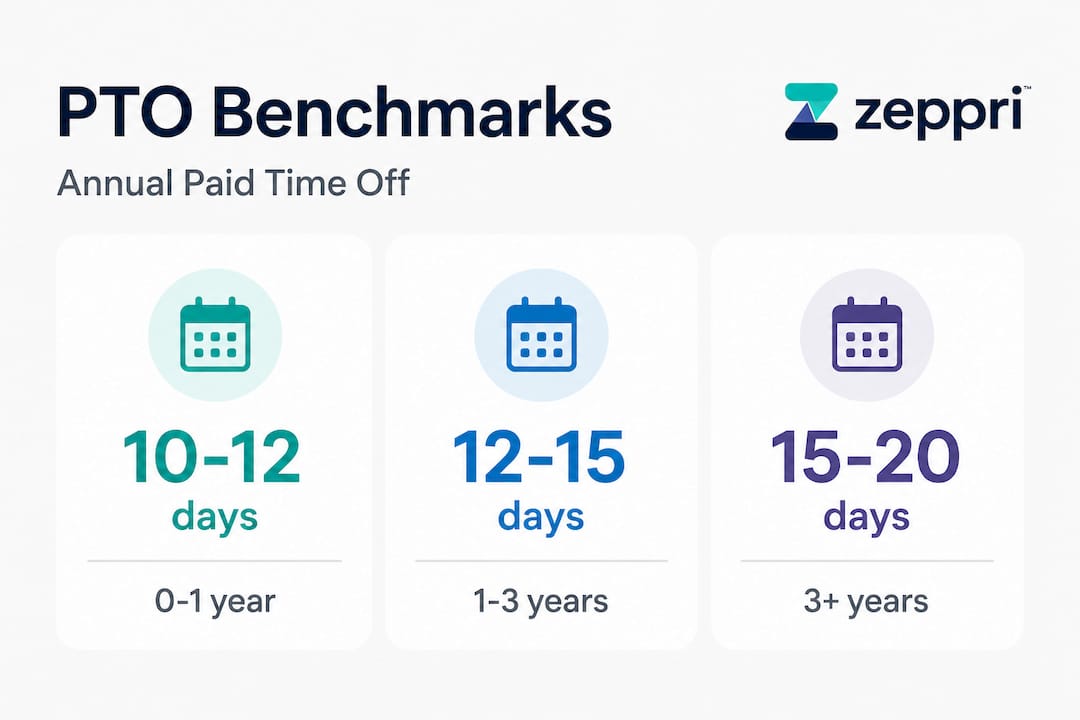
These figures represent broadly observed norms, not guarantees, but they give HR teams a useful benchmark when designing or reviewing leave structures. The key tension in PTO design is simplicity versus control. A single PTO pool is administratively cleaner and preferred by employees. However, it can complicate planning because an employee might use all their days for vacation and then have no buffer for illness, creating coverage gaps you didn't anticipate.
Organizations using separate sick and vacation leave structures have more predictability for planning purposes, since sick leave usage tends to cluster in specific months (flu season, allergy season), while vacation leave spreads more evenly. When organizations evaluate their policy design, size and industry matter enormously.
Steps for aligning your time-off structure with organizational needs:
- Audit your current leave categories and whether employees understand how to use them
- Benchmark your PTO totals against your industry using current survey data
- Decide whether a unified PTO model or separate buckets better matches your workforce demographics
- Define blackout periods for peak operational demand, and communicate them well in advance
- Review accrual rates annually to ensure they remain competitive and financially sustainable
HR teams managing multiple departments or locations benefit significantly from using a consistent step-by-step shift scheduling approach that integrates leave requests directly into the scheduling workflow, rather than managing them as separate parallel processes.
Access, awareness, and fairness: Making time-off truly work
Here's what most organizations don't want to hear: your leave policy may be generous on paper and doing almost nothing for actual well-being. Work-life balance policies may have small or inconsistent effects depending on how inclusively they are implemented and used. That means access, awareness, and supervisory behavior matter as much as policy design.
"Even generous leave policies can underperform if employees fear consequences or perceive approval bias. Management needs consistent, transparent approval rules and active support to prevent 'policy on paper' from diverging from real access."
Think about what that means in practice. An employee in one department takes two weeks off in August without any friction. An employee in a neighboring department with the same policy hesitates to request even a long weekend because their manager is known for passive-aggressive responses to leave requests. Same policy. Very different reality.
Common barriers that prevent employees from using their leave:
- Fear of being labeled uncommitted or a low performer
- Unclear approval criteria that vary by manager
- No visibility into how much leave coworkers are taking (which would normalize usage)
- Heavy workloads with no handoff support, making taking time off feel irresponsible
- Past experiences of denied requests without adequate explanation
Strategies to promote fairness and actual access include policy education sessions during onboarding and annually, not just when problems arise. Transparent approval rules, published and accessible to all employees, remove ambiguity. Manager enablement is equally critical: train supervisors on how to evaluate leave requests consistently, how to document denials, and how to create a team culture where taking leave is seen as normal, not exceptional.
Using time tracking tools built for managers gives HR leaders data to monitor whether leave is being used equitably across teams. If one department consistently shows low leave utilization despite available balance, that's a signal worth investigating before it becomes a talent retention problem.
Pro Tip: Conduct a biannual leave audit. Compare leave utilization rates across departments and managers. If you see major disparities, investigate before assuming it's a coincidence. Patterns often reveal supervisory bias or cultural norms that your written policy never intended to create.
Why most organizations get time-off management wrong (and how to fix it)
After reviewing the evidence and talking to HR leaders across industries, one thing stands out clearly: the gap between policy intent and actual results is almost always a people problem, not a policy problem. Organizations write thoughtful leave policies, benchmark their PTO against competitors, and then hand enforcement to managers who receive zero training on how to apply those policies consistently or compassionately.
Most managers think their job in leave management is to minimize disruption to their team's output. That's only half right. Their job is to balance operational needs with genuine employee recovery, and those two things are not as opposed as managers instinctively assume. An employee who takes leave, actually recovers, and returns refreshed is a better performer than one who grinds through 50 weeks of work without meaningful rest.
The organizations that capture real value from time-off programs share a few non-obvious habits. They treat manager training on leave administration as seriously as technical skills training. They publish aggregate leave usage data internally so employees can see that taking leave is culturally normal. And they build feedback loops, asking employees annually whether they feel genuinely supported in using their benefits.
Real-world time-off tips consistently point to one underrated lever: normalizing leave from the top. When executives and senior leaders visibly take their full leave allocation and talk about it openly, the cultural permission flows down. When leadership works through vacations or responds to emails at midnight, no written policy in the world will convince frontline employees that taking time off is truly safe.
The practical fix is more achievable than most organizations think. Audit your approval data for bias patterns. Train managers on consistent, documented decision-making. Build leave into operational planning from day one rather than treating it as an exception to manage. And measure utilization, not just availability, as a key workforce health indicator.
Streamline your time-off processes with Zeppri
Managing time-off effectively requires more than good intentions. It requires systems that give managers real-time visibility and give employees frictionless access to request, track, and plan their leave without confusion or delay.
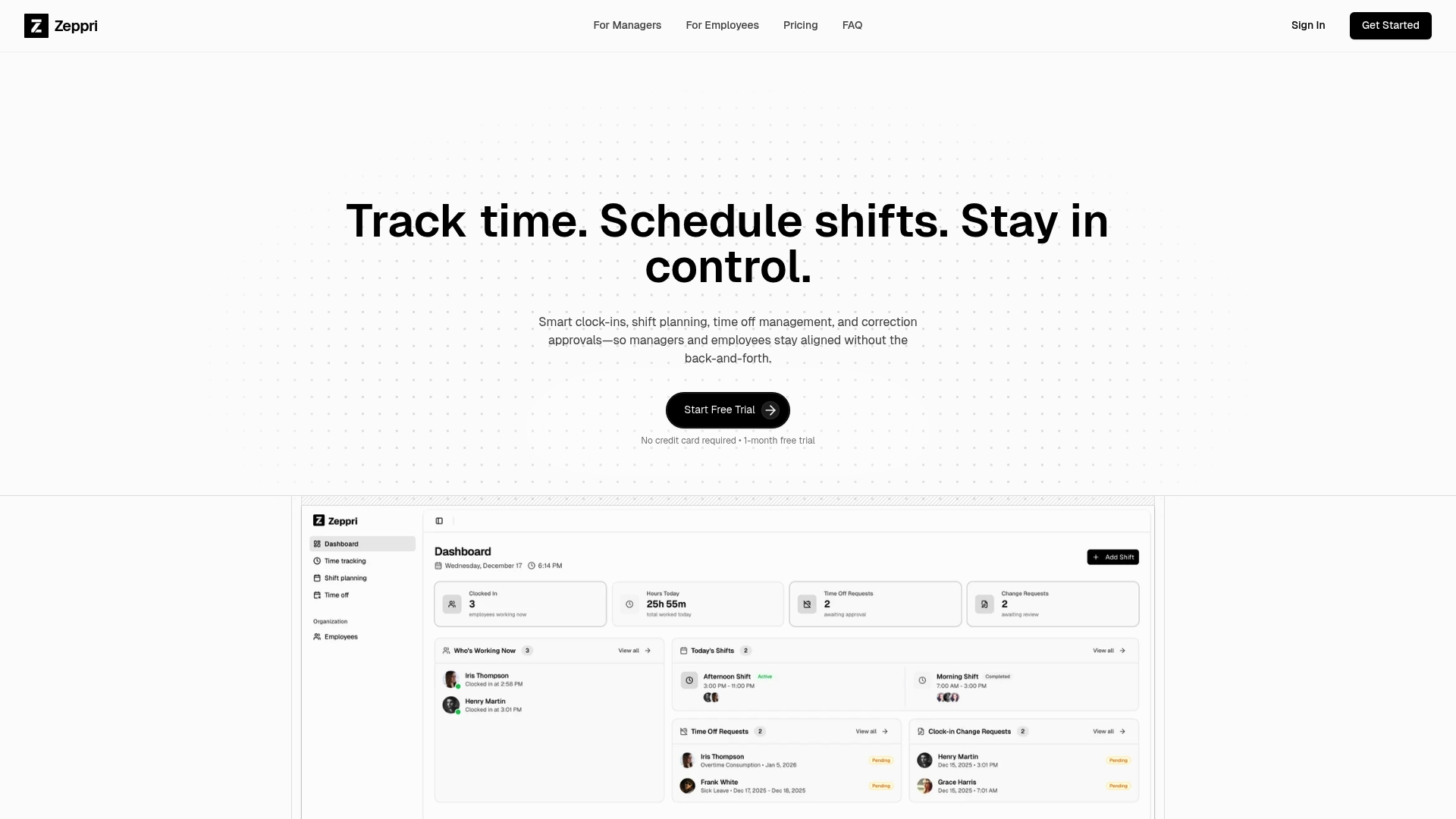
Zeppri's workforce management platform centralizes time-off requests, approvals, and leave balances in one intuitive dashboard. Employees submit requests through the mobile app, managers respond with full context on team coverage, and HR has the reporting data needed to spot utilization patterns and flag equity concerns. From automated time tracking to shift scheduling and attendance management, Zeppri helps organizations close the gap between leave policies that look good on paper and leave programs that actually deliver results. If your team is ready to make time-off management a genuine operational strength, Zeppri gives you the tools to do it efficiently and at scale.
Frequently asked questions
What is the main purpose of time-off management?
The main purpose is to ensure organizations maintain operational continuity and employee well-being by planning coverage efficiently and reducing avoidable disruptions.
Does more paid time off automatically improve employee well-being?
No. Leave policy effects can be small or inconsistent depending on how inclusively they are implemented. Real impact depends on employee access, awareness, and manager support, not just the amount of leave offered.
How do most organizations structure time-off?
Most employers combine vacation and sick leave into a single PTO pool, with the number of available days typically increasing with employee tenure.
What barriers prevent employees from taking time off?
Common barriers include fear of being seen as less committed, low awareness of their own policy entitlements, inconsistent approval standards between managers, and heavy workloads with no support structure for handing off tasks during absence.